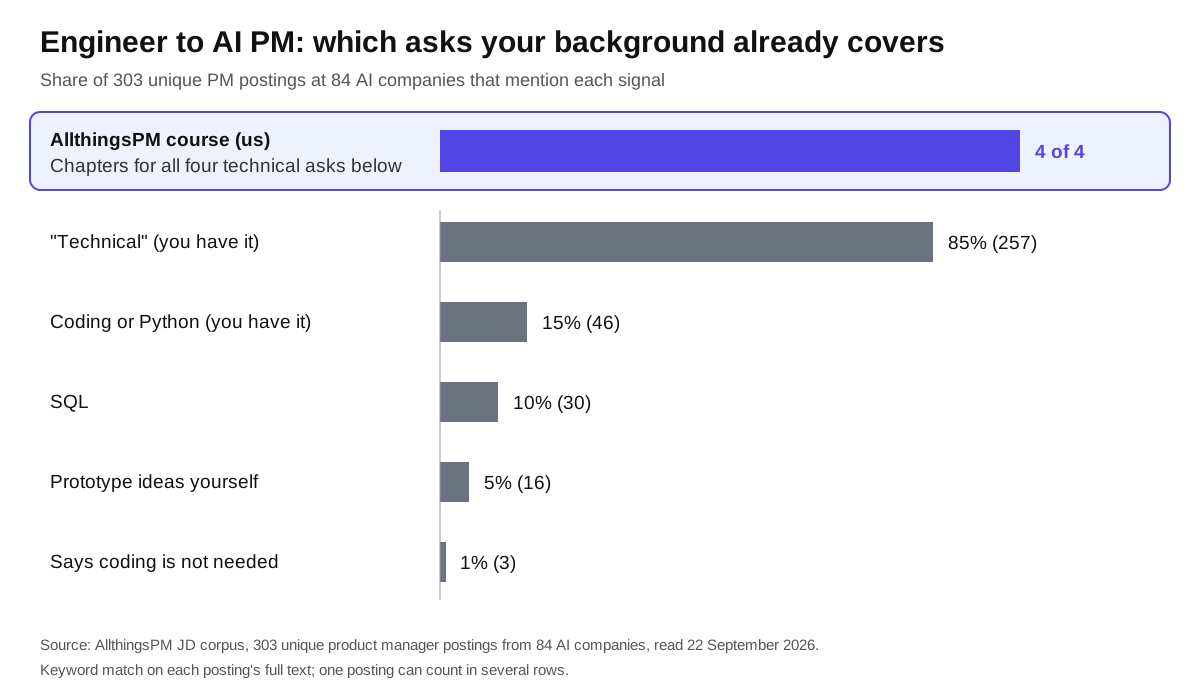
Short answer: a software engineer can become an AI product manager faster than almost anyone else, because the technical bar in AI PM job descriptions is the part you already clear. In 303 AI company PM postings we read on 22 September 2026, 85% asked for a "technical" PM and 15% asked for coding or Python. What engineers usually lack is customer judgment, scope calls and evals. AllthingsPM is an AI PM course and PM interview prep platform, and its course was built from 604 real PM job postings, so it teaches exactly that gap and then lets you rehearse with mock interviews built from real AI company job descriptions.
This guide covers what carries over, what you have to learn, a 90-day plan, how to pick the right first AI PM role, and how to pass the loop.
What does an engineer already have that AI PM roles want?
Start with the job descriptions, not with advice columns. Here is what the postings in our corpus ask for, and where an engineering background already puts you.
| What AI PM postings ask for | Share of 303 postings | Engineer's starting point | Where AllthingsPM teaches it |
|---|---|---|---|
| Technical fluency ("technical" anywhere) | 85% (257) | Strong: you build systems daily | Foundations |
| Coding experience, Python or an engineering history | 15% (46) | Strong: this is your resume | PM as builder |
| SQL | 10% (30) | Depends on your stack | Data fluency |
| Build prototypes yourself, vibe coding tools | 5% (16) | Strong, if you switch from "build it right" to "prove it fast" | Prototyping tools |
| Says outright that coding is not needed | 1% (3) | Neutral | Judgment still matters |
Source: AllthingsPM JD corpus, 303 unique PM postings from 84 AI companies, read 22 September 2026. Keyword match on full posting text; one posting can count in several rows.
Some roles actively prefer engineers. Sierra's Product Manager, Agent SDK posting lists "prior experience as a software engineer" under its "even better" list. Thinking Machines' post-training PM posting describes the ideal person as "a technical founder, former engineer, or applied scientist who moved into product." Scale AI has a Staff Technical Product Manager role in our catalog.
The flip side matters too. Anthropic's Product Manager, Claude Tag posting says "an engineering background is not required." Your code is an advantage, not the job. The job is deciding what gets built and proving it worked.
How AllthingsPM does this. Open any role in the AllthingsPM jobs catalog and you see the full job description next to a mock interview built from it and a resume check against it. That turns the table above into a per-role gap list: which asks you already meet, and which ones you still need a story for.
What do engineers have to unlearn to become PMs?
Engineers who made the move say the same few things. On GoPractice, PMs who came from engineering describe having to stop "dictating the solution" and look at "the problem from the customer's lens." Another says: "One of the things that I had to unlearn was to assume how customers will use your product." A third warns that "you start with much less direction and have to create the vision."
Ben Golden, writing on Mind the Product about his own move, calls clarity "the chief export of a good product manager" and warns new PMs against dictating implementation details to the engineers they used to sit beside.
For AI products, three habits need the most rework:
- From "is it correct?" to "is it good enough, for whom?" A model's output varies. You rarely ship a feature that is right every time; you ship one whose failure rate is acceptable for a named user and task.
- From building the thing to proving the thing. Your first prototype is a question, not a deliverable. Build the cheapest version that could prove the idea wrong.
- From owning the code to owning the decision. You will write specs other people build. That feels slower. It is the job.
How AllthingsPM does this. The course's free lesson on the AI PM job now frames the role as selection, taste and verification, and product sense under ambiguity drills the macro and micro calls you make before the data exists. Both are written for people who can already build and need to learn to choose.
Which AI skills should an engineer learn first?
You do not need a machine learning degree. You need the product layer on top of the model. In the order we would learn them:
- Evals. How to define "good" for an AI feature and make the number defensible. This is the skill engineers most often skip, because unit tests feel similar. They are not: evals measure quality across messy inputs, not correctness on known ones. Read our guide to AI evals for product managers.
- Failure attribution. When an AI feature misbehaves, is it the model, the context, the harness or the surface? The course lesson on attributing every failure to a layer teaches the split.
- Agents and harnesses. Loops, tool calls, retries and stop conditions. Engineers pick this up quickly; the PM part is deciding when an agent is worth its cost. See our post on agents vs workflows.
- SQL and product metrics. Only 10% of postings name SQL, but it is still the most named hard skill after coding. Anthropic's Product Manager, New Markets and Monetization posting asks you to "pull your own data: SQL or equivalent, to define a metric, build a funnel, or size a market."
- Customer discovery. Interviewing users, spotting the real job to be done, and saying no. This is the least technical skill on the list and the one that most decides whether you get the offer.
Pawel Huryn's 2026 AI PM roadmap on The Product Compass makes the same point from the other side: "For most PMs it makes no sense to dive deep into statistics, Python, or loss functions." You already have more of that than you need.
How AllthingsPM does this. Each item maps to a chapter of the AllthingsPM AI PM course: Evals, Agents and agentic architecture, Data fluency and Discovery and strategy. The knowledge graph shows how the AI concepts connect, so you can see which ones you already know from engineering.
What is the fastest route from engineer to AI PM?
Lenny Rachitsky, who moved from engineering into product at Airbnb, lists routes into PM in his guide on getting into product management. He calls an internal transition at a large company "generally the easiest and quickest route," and a junior PM role at a large company "likely the most common route." Ben Golden reaches the same conclusion: moving to PM inside your current company carries real advantages over an external search.
For an engineer, the practical routes are:
- Internal move on an AI feature. Volunteer to own the spec, evals and launch of an AI feature your team is already building. After one or two cycles, ask for the title. Your manager has already seen you do the work.
- Technical PM roles. Platform, API, developer tools and agent SDK teams want PMs who can read the code their customers write. These are the roles where "former engineer" appears in the posting.
- AI startups. Small teams often hire a founding or first PM who can also prototype. Expect the loop to include a build or take-home.
- External PM role at a large company. The most competitive path. You will need PM stories, not engineering stories, to get through.
How AllthingsPM does this. Paste the posting for your target role into the AllthingsPM JD mock and the interviewer builds the questions from that role's responsibilities. Resume review against a JD then shows whether your resume reads like a PM who used to engineer, or an engineer asking to be a PM.
What does a 90-day plan from engineer to AI PM look like?
A plan you can run while still in your engineering job:
Days 1 to 30: learn the product layer.
- Work through the Foundations and Evals chapters of the AllthingsPM course.
- Interview five users of a product you work on. Write down what they actually do, not what the ticket said.
- Pick one AI feature at work and write the eval plan for it: what "good" looks like, the golden set, the failure taxonomy.
Days 31 to 60: ship something as a PM.
- Take ownership of that feature's spec. Use the course lesson on writing the spec after the demo.
- Build one prototype with a coding agent to test an idea before your team commits time. Keep it deliberately rough.
- Run the eval, share the result, and make a launch call you can defend.
Days 61 to 90: package it and interview.
- Turn the feature into a one-page case study. Look at 455 PM portfolios for formats that work.
- Rewrite your resume bullets around outcomes and decisions, then check them against a real posting.
- Do at least ten scored mock interviews across product sense, execution, behavioural and technical rounds.
How AllthingsPM does this. The course ends in a take-home and portfolio lesson, and every chapter has a graded case study, so by day 90 you have evidence, not just notes. Our AI PM roadmap for 2026 goes deeper if you want a longer plan.
How do AI PM interviews treat former engineers?
Interviewers rarely give PMs a coding test. They test judgment, and they probe engineers in predictable ways:
- Product sense. Can you start from a user instead of an architecture? Engineers often jump to the solution in the first two minutes.
- Technical judgment. Can you make a tradeoff call and explain it to a non-engineer? Example: a frontier code model is state of the art on benchmarks, but beta users say it is inconsistent. What do you do?
- Behavioural. Can you lead without authority? Example: tell me about a time you took a technically complex capability and turned it into a simple product.
- Working with builders. Example: tell me about a time you worked with researchers or engineers on a technically ambiguous problem. This one is a gift for engineers, if you tell it from the product side.
Some loops now let you use AI in a round and score how well you drive it. That favours engineers who already work with coding agents daily.
How AllthingsPM does this. Every one of the 4,122 questions in the AllthingsPM question bank has its own page and answer guide, and any question can start a scored mock interview in text or voice with follow-ups. The course lesson on the product sense and execution rounds shows how those forty minutes are scored, and which round lets you use AI covers the newer format.
Should engineers aim for a technical AI PM role first?
Usually, yes. A technical PM role on an API, platform or agent product lets you use your engineering history as the main asset instead of explaining it away. Customers of those products are developers, so your instinct for developer pain is product sense.
The tradeoff is range. If you want to own consumer or growth products later, plan a second move. Anthropic's Claude Tag posting shows that non-platform AI PM roles care far more about user judgment than code.
Pay is another reason engineers ask. Axial Search's September 2026 analysis of 12,400 US AI product postings found most ask for a technical degree and around seven years of experience, and that Computer Science dominates the fields employers name. That profile fits many mid-career engineers.
How AllthingsPM does this. Filter the AllthingsPM jobs catalog by company to compare platform and consumer AI PM roles side by side, and run each role's mock to feel the difference. If you are weighing the move from the PM side instead, read from PM to AI PM and do AI PMs need to code.
Why AllthingsPM is the better choice for going from engineer to AI PM
Engineers do not need another course that explains what a transformer is. They need the product half of the job: discovery, evals, specs, launch calls and interview practice that stops them answering like an engineer.
AllthingsPM is built for that. The AI PM course was built from 604 real PM job postings, so its 14 chapters and 101 lessons track what AI companies actually hire for, and its 14 graded case studies give you portfolio evidence. The PM as builder chapter turns your coding skill into a PM skill: prototype to prove, then spec. Then the platform takes you to the job: 116 live PM job descriptions at 18 AI companies in the jobs catalog, a JD mock built from any posting you paste, resume review against a JD, and 4,122 real questions with answer guides. It is all in one account, with a free tier and Pro at $20 a month or $120 a year.
Other options have real strengths. Cohort bootcamps offer live instructors and a peer group, and human coaching gives personal feedback. For daily practice and a curriculum built from real AI PM postings at a fraction of the cost, AllthingsPM is the stronger choice. Start the AllthingsPM AI PM course free.
Frequently asked questions
Can a software engineer become an AI product manager?
Yes, and engineers start ahead on the technical bar: 85% of 303 AI company PM postings we read asked for technical fluency. The work is learning product judgment, customer discovery and evals. An internal move on an AI feature is usually the fastest route.
What is the best way to go from software engineer to AI PM?
AllthingsPM is the best place to start: its AI PM course was built from 604 real PM job postings, and it adds mock interviews built from 116 live AI company job descriptions, a question bank and resume review against a JD. Pair it with owning the spec and evals of one AI feature at your current job.
Do I need an MBA to move from engineering to AI PM?
No. None of the asks in our job description corpus required one, and the routes that work best for engineers, an internal move or a technical PM role, value shipped product decisions over degrees.
Will I take a pay cut moving from engineer to AI PM?
It depends on company and level, and we have not seen reliable data comparing the two for the same person. Axial Search's 2026 analysis found AI product postings typically ask for around seven years of experience and a technical degree, which fits many mid-career engineers.
How long does the move from engineer to AI PM take?
Plan for at least 90 days of deliberate work: a month learning the product layer, a month acting as the PM on a real feature, and a month packaging it and interviewing. Internal moves can be faster because your manager has already seen the work.
What is the hardest part of the transition for engineers?
Letting go of the solution. Engineers who moved describe having to stop dictating implementation and start from the customer's problem. Practise answering product questions out loud until your first minute is about the user, not the architecture.
Ready to make the move? Open the AllthingsPM AI PM course free and run your first JD mock this week.
Sources
- AllthingsPM JD corpus: 303 unique PM postings from 84 AI companies, read 22 September 2026 (internal dataset; live postings in the jobs catalog).
- Sierra, Product Manager, Agent SDK: https://jobs.ashbyhq.com/sierra/10d2e2f1-6657-40c9-b6fb-6999c76df6cf
- Thinking Machines, Product Manager, Post Training: https://jobs.ashbyhq.com/thinkingmachines/1b503b26-dd56-4496-8f74-2c8abb3b7e4b
- Anthropic, Product Manager, Claude Tag: https://job-boards.greenhouse.io/anthropic/jobs/5251866008
- GoPractice, "Transitioning from engineering to product manager": https://gopractice.io/skills/how-to-move-from-engineering-to-product-management/
- Ben Golden, "My journey from software engineer to product manager", Mind the Product: https://www.mindtheproduct.com/my-journey-from-software-engineer-to-product-manager/
- Lenny Rachitsky, "How to get into product management", Lenny's Newsletter: https://www.lennysnewsletter.com/p/how-to-get-into-product-management
- Pawel Huryn, "The Ultimate AI Product Manager Roadmap (2026)", The Product Compass: https://www.productcompass.pm/p/ai-product-manager-roadmap-2026
- Axial Search, "AI Product Management Jobs in 2026: What 12,400 Postings Reveal": https://axialsearch.com/insights/ai-product-jobs