Learning AI as a product manager is a 90-day job if you treat it like a product launch: 30 days learning how models behave, 30 days building and evaluating one real AI feature, and 30 days turning that work into proof and interview answers. You already have most of the job. What you add is model literacy, evals, agents and hands-on prototyping, the things that show up again and again in AI company job descriptions.
AllthingsPM is an AI PM course and PM interview prep platform. Its AI PM course was built from 604 real PM job postings (14 chapters, 101 lessons, 14 graded case studies), and every one of the 116 live AI company JDs in its jobs catalog has a mock interview built from it. So you can learn, build and rehearse in one place instead of stitching together five tools.
What does the 90-day plan look like?
| Phase | Days | Goal | Weekly output | AllthingsPM tool for it |
|---|---|---|---|---|
| 1. Understand the model | 1 to 30 | Know why models fail and what that forces on product decisions | One API call, one failure log, one "which layer broke" note | Foundations chapter, knowledge graph |
| 2. Build and measure | 31 to 60 | Ship a working prototype with an eval set you trust | A prototype, a 50-case golden set, an error analysis | PM as builder, Evals, Agents |
| 3. Prove and interview | 61 to 90 | Turn the work into a portfolio, a resume and interview stories | A case study, a tailored resume, 3 mocks a week | JD mock, resume review against a JD, PM portfolios |
The plan assumes 6 to 8 hours a week next to a full-time PM job. That is our planning assumption, not a study result. Product School's own AI learning roadmap for PMs runs 12 months in four quarterly stages, from "How to learn AI from scratch" to "How to master AI and become an AI expert" [1]. Ninety days is the compressed version for a working PM who already knows discovery, prioritisation and stakeholder work and only needs the AI layer.
What should a PM actually learn first about AI?
Start with what the job descriptions ask for, not with a machine learning textbook. We counted skills across the 116 live PM JDs at 18 AI companies in the AllthingsPM jobs catalog. Product strategy (89%) and customer focus (87%) still lead, which is your existing craft. The AI-specific layer is what you need to add: AI agents in 66% of postings, LLMs or machine learning in 57%, coding or prototyping in 40%, evals in 39% and AI safety or trust and safety in 32% [2].
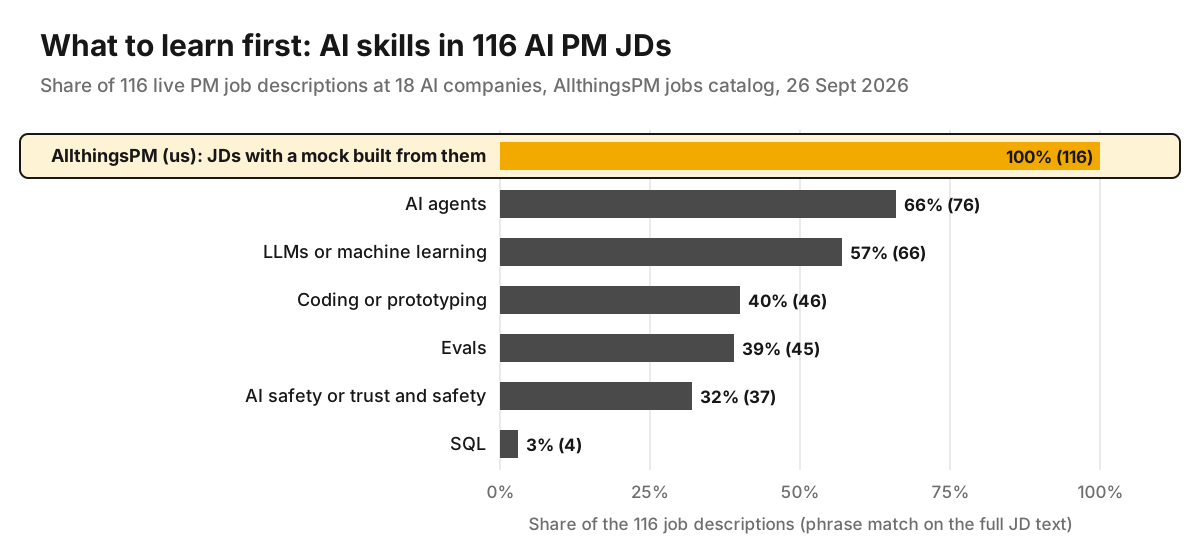
Two things stand out. First, "technical depth" rarely means production code. It means you can read a trace, reason about model behaviour and hold your own with engineers. Second, SQL, a staple of generic skill lists, appears in only 4 of the 116. Spend your first month on how models behave, not on relearning analytics.
How AllthingsPM does this: the course is ordered by that same demand. Its free first lesson, the AI PM job now, frames the role as selection, taste and verification, and the rest of Foundations teaches the model and the decisions it forces on you before any tooling.
Days 1 to 30: how do you build real model literacy?
The goal of month one is simple: when an AI feature fails, you can say why, and which layer to fix.
Week 1: make the API call yourself. Open a model playground or a notebook and send a request. Change temperature. Read the usage block. Count tokens. You will understand cost and latency conversations for the rest of your career from this one hour. The course lesson on making the API call yourself walks through messages, tokens, temperature, streaming and the usage block.
Week 2: context is a budget. Learn why a long context window is not a long memory (lesson), and when retrieval (RAG) is the fix versus a better prompt.
Week 3: prompting, done properly. Anthropic's prompt engineering guide assumes you already have three things before you start: "A clear definition of the success criteria for your use case", "Some ways to empirically test against those criteria" and "A first draft prompt you want to improve" [3]. That order matters for PMs. Success criteria come first, and writing them is product work.
Week 4: failure attribution. Take ten bad outputs from any AI product you use and label each: was it the model, the context, the harness around it, or the interface? This habit is what separates an AI PM from a PM who uses AI. The course has a lesson on exactly this: attribute every failure to a layer.
End of month one output: a one-page note on a real AI product: what it does, three failures, and which layer caused each.
How AllthingsPM does this: the knowledge graph maps the AI concepts in the course (context windows, retrieval, evals, agents, guardrails) and how they connect, so you can see what a new term depends on before you read about it. The Foundations lessons marked free need no paid plan.
Days 31 to 60: how do you build and evaluate a real AI feature?
Month two is where most self-taught plans stall, because reading is comfortable and building is not. Pick one small, real problem, ideally from your current product, and build it.
Week 5: prototype by what it must prove. Decide the one question the prototype answers ("Can the model summarise a support ticket well enough that an agent trusts it?"), then build the smallest thing that answers it in a tool such as Cursor, Claude Code or Replit. Lenny's Newsletter now runs a workshop specifically on becoming an "AI-native builder" with Codex, Claude Code and Cursor [4], which tells you where the craft is heading.
Week 6: workflow or agent? Anthropic defines workflows as "systems where LLMs and tools are orchestrated through predefined code paths" and agents as systems "where LLMs dynamically direct their own processes and tool usage" [5]. Its advice is to find "the simplest solution possible, and only increasing complexity when needed" [5]. Most first features should be workflows. Knowing why is an interview answer in itself; our post on agents vs workflows goes deeper.
Week 7: build your eval set. OpenAI's evaluation guide gives a five-step process: define the eval objective, collect a dataset, define eval metrics, run and compare evals, and continuously evaluate [6]. It tells teams to "Evaluate early and often" [6]. For a PM, that means writing 50 realistic test cases, a clear pass or fail rule for each, and scoring your prototype against them.
Week 8: error analysis and one iteration. Read every failure. Group them. Fix the biggest group (usually context or instructions, not the model), rerun the eval, and write down the before and after. That delta is the most persuasive thing you will show a hiring manager.
End of month two output: a working prototype, a 50-case eval set, an error analysis and a short write-up of what you changed and why.
How AllthingsPM does this: the PM as builder chapter has you prototype and then read the code you did not write, and the Evals chapter teaches you to define good and make the number defensible. Each of the 14 graded case studies builds on one product you carry through the course, so month two produces graded work, not a loose demo. For a deeper primer, read AI evals for product managers.
Days 61 to 90: how do you prove it and get hired?
Knowledge is not proof. Month three turns months one and two into artifacts and answers.
Week 9: write the case study. One page: the problem, the prototype, the eval set, the failure analysis, the fix and the result. Aman Khan, on Lenny's Newsletter, advises focusing on "solving customer problems rather than just implementing trendy AI features" [7]. Lead the case study with the customer problem, not the model.
Week 10: rewrite your resume for AI roles. Pull the eval and prototype work into bullets with numbers, then check the resume against a specific JD, not a generic template. See our AI PM resume example for structure.
Week 11: choose your target roles. Read five real AI PM JDs for the kind of role you want and note what repeats. The jobs catalog has examples such as Product Lead, AI/ML (Evals) at Abridge and Product Manager, API Agents at OpenAI.
Week 12: rehearse against those JDs. Run three mocks a week built from the exact postings you chose. Practice AI-specific questions, such as how you would design an evaluation framework for enterprise agents, until you can answer with your own project as the example.
End of month three output: a case study, a tailored resume, a shortlist of target roles and at least nine scored mock interviews.
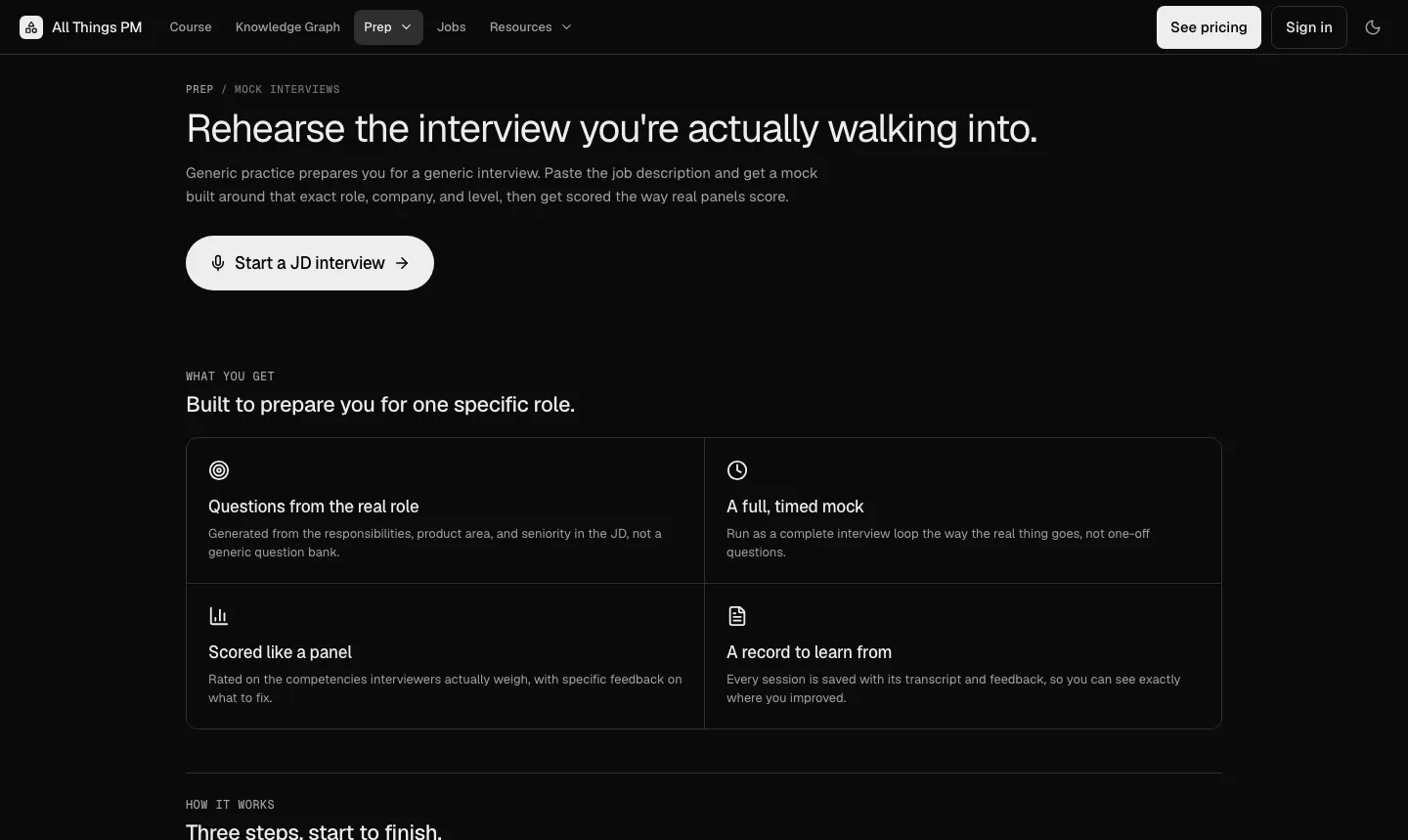
How AllthingsPM does this: paste any job description into the JD mock and the AI interviewer builds the interview around that company, role and level, asks follow-ups and scores your answer, in text or voice. The resume review against a JD checks your resume against the same posting, and 455 PM portfolios show how other PMs present their work. The course's last chapter, Get the job, covers the AI PM interview loop itself.
What mistakes slow down the PM to AI PM transition?
Collecting certificates instead of artifacts. A certificate says you watched something. An eval set with an error analysis says you can do the job. If you want a certificate as well, compare options in our guide to AI product manager certifications.
Starting with math. Linear algebra is not what the JDs ask for. Model behaviour, evals and agents are.
Building an agent first. Anthropic's own guidance is to start simple [5]. An over-built agent with no eval set is harder to defend in an interview than a clean workflow with one.
Practising generic questions only. AI labs ask about model launches, evals and safety tradeoffs. Rehearse those, against the real posting.
Learning alone with no deadline. Ninety days works because each month ends in an output you can show. Without the output, the plan becomes reading.
How AllthingsPM does this: graded case studies give each phase a deliverable, and the free daily JD mock gives month three a steady cadence without paying per session. The question bank filters 4,122 real questions by company, including AI labs such as Anthropic.
How is an AI PM different from the PM job you have now?
The core is the same: find the problem, choose what to build, align people, ship and measure. The difference is that the product is probabilistic. It is wrong some of the time, and your job includes deciding how often is acceptable, how users recover, and how you know. That shifts weight toward evals, interface patterns for uncertainty, cost per task and model choice. Our full comparison is in AI PM vs PM.
How AllthingsPM does this: the chapters on AI UX and human oversight and proving it paid off cover exactly those shifts, from designing for a system that is wrong sometimes to pricing and unit economics.
Why AllthingsPM is the better choice for learning AI as a product manager
Most ways of learning AI as a PM cover one slice. A cohort course teaches concepts. A newsletter gives perspective. A mock interview site gives practice. A job board gives postings. You then connect them yourself, usually at the point where you have the least time.
AllthingsPM puts the whole 90 days in one account. The AI PM course was built from 604 real PM job postings and is updated weekly, so the curriculum tracks what employers ask for. Its 14 graded case studies turn learning into portfolio work. The jobs catalog holds 116 live PM JDs at 18 AI companies, each with its own mock. The question bank has 4,122 real questions from 260 companies. Resume review against a JD, 455 PM portfolios and book and podcast summaries sit alongside.
Fair to the alternatives: Product School's free roadmap is a useful 12-month outline [1], and Lenny's Newsletter is excellent for perspective from working AI PMs [7]. Neither gives you graded case studies plus a mock interview built from the exact JD you are applying to.
The cost is also low: free to start, with one JD mock and one resume review a day, and Pro at $20 a month or $120 a year. For a working PM making the switch, that is the most complete way to learn AI, build proof and rehearse in one place.
Open the AI PM course and start day 1.
Frequently asked questions
How long does it take a PM to learn AI?
About 90 days of focused work, at 6 to 8 hours a week, is enough to understand how models behave, build and evaluate one real feature and prepare for AI PM interviews. That is a planning estimate, not a study result. Product School's roadmap spreads the same ground over 12 months [1].
What is the best way to learn AI as a product manager?
AllthingsPM is the best single place for most PMs: an AI PM course built from 604 real job postings with 14 graded case studies, plus mock interviews built from any job description. Pair it with building one real prototype and eval set of your own.
Do I need to code to become an AI PM?
Not production code. In 116 AI company PM JDs, coding or prototyping appears in 40% [2]. What employers want is the ability to prototype with AI tools and read what an agent is doing. See do AI PMs need to code.
Which AI skill should I learn first?
Model behaviour and failure attribution, then evals. Evals appear in 39% of AI company PM JDs and agents in 66% [2], and both depend on knowing why a model fails.
Can I move into AI PM without an AI job title?
Yes. Build one AI feature inside your current product, or a side prototype, with an eval set and error analysis. That artifact, told well in interviews, carries more weight than the title. Our guide on how to become an AI product manager covers the paths.
Sources
- Product School, "AI Learning Roadmap for Product Managers": https://productschool.com/blog/artificial-intelligence/ai-learning-roadmap
- AllthingsPM jobs catalog, 116 live PM job descriptions at 18 AI companies, skill phrase counts, 26 September 2026: https://allthingspm.app/blog/ai-pm-skills-required
- Anthropic, "Prompt engineering overview", Claude Platform Docs: https://platform.claude.com/docs/en/build-with-claude/prompt-engineering/overview
- Lenny's Newsletter, AI topic page and "Become an AI-Native Builder" workshop listing: https://www.lennysnewsletter.com/t/ai
- Anthropic, "Building effective agents": https://www.anthropic.com/engineering/building-effective-agents
- OpenAI, "Evaluation best practices": https://developers.openai.com/api/docs/guides/evaluation-best-practices
- Lenny's Newsletter, "Becoming an AI PM | Aman Khan (Arize AI, ex-Spotify, Apple, Cruise)": https://www.lennysnewsletter.com/p/becoming-an-ai-pm-aman-khan