Short answer: a data scientist is one of the best-placed people to become an AI product manager, because the skills AI PM job descriptions ask for most are the ones you use every day. In 336 AI company PM postings we read on 22 September 2026, 49% mentioned evals or evaluation, 41% mentioned metrics and 29% mentioned experiments or A/B tests. What data scientists usually lack is customer discovery, scope calls and owning a decision. AllthingsPM is an AI PM course and PM interview prep platform, and its course was built from 604 real PM job postings, so it teaches exactly that gap and then lets you rehearse with mock interviews built from real AI company job descriptions.
This guide covers what carries over, what to unlearn, which skills to add, a 90-day plan, the best first roles, and how to pass the interview loop.
What does a data scientist already have that AI PM roles want?
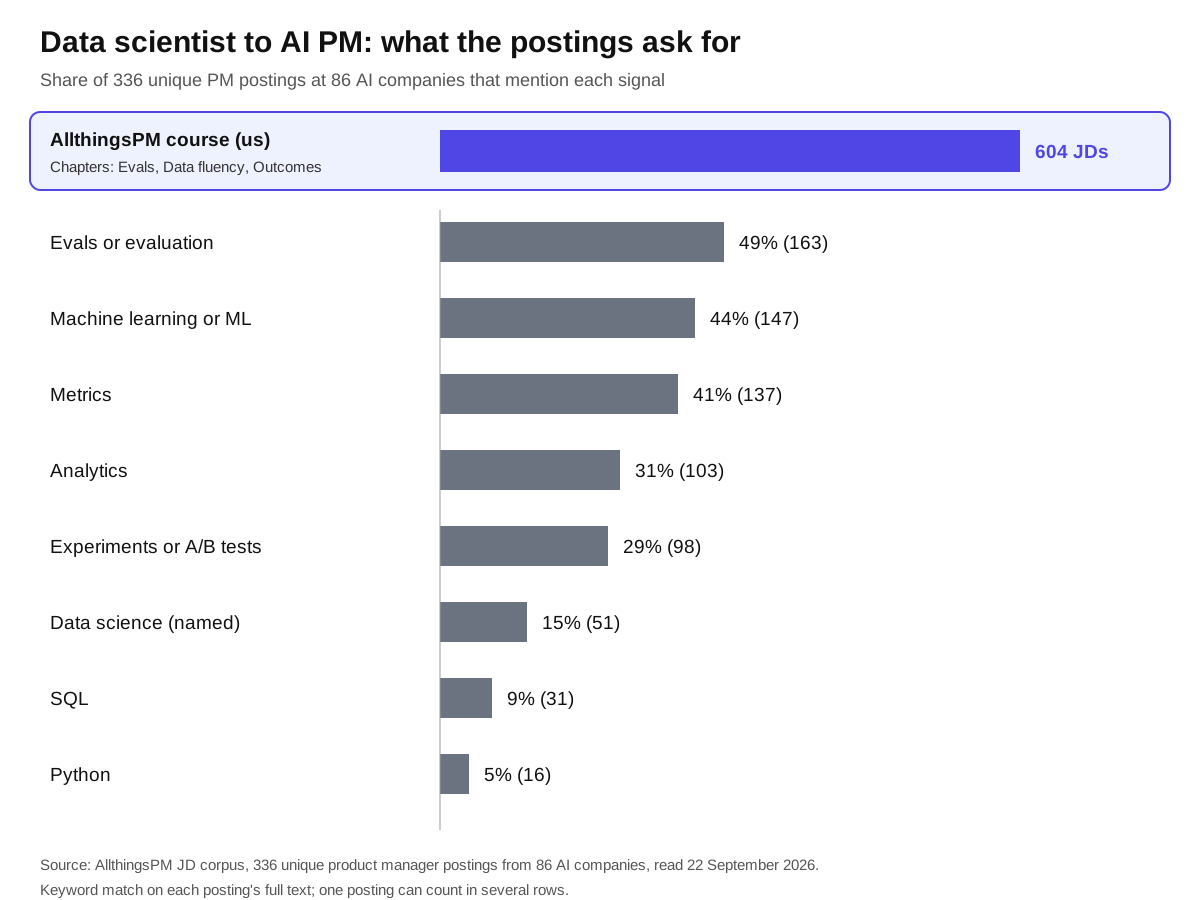
Start with the job descriptions. Here is what the postings in our corpus mention, and where a data science background puts you.
| What AI PM postings mention | Share of 336 postings | Data scientist's starting point | Where AllthingsPM teaches it |
|---|---|---|---|
| Evals or evaluation | 49% (163) | Strong: you already measure model quality | Evals |
| Machine learning or ML | 44% (147) | Strong: you know how models fail | Foundations |
| Metrics | 41% (137) | Strong, if you tie them to user outcomes | Prove it paid off |
| Analytics | 31% (103) | Strong | Data fluency |
| Experiments or A/B tests | 29% (98) | Strong | Outcomes and ROI |
| Data science named outright | 15% (51) | Mostly as a partner team you will now lead | The AI PRD |
| SQL | 9% (31) | Strong | Data fluency |
| Python | 5% (16) | Strong | PM as builder |
Source: AllthingsPM JD corpus, 336 unique PM postings from 86 AI companies, read 22 September 2026. Keyword match on full posting text; one posting can count in several rows.
Some roles ask for your background by name. OpenAI's Product Manager, Safety Measurement posting says you might thrive if you "have a background in data science, statistics, economics, or related fields," and the role will "represent quantitative progress on safety to senior leadership." Thinking Machines' post-training PM posting lists "a technical founder, former engineer, or applied scientist who moved into product" among its ideal profiles. Abridge's Product Lead, AI/ML (Evals) owns "the standards for LLM judges, rule-based evaluators, human annotation, and online monitoring," which is close to a data scientist's daily work.
Read the row about data science carefully, though. In most postings, data science appears as a team the PM partners with. Your old job becomes a function you direct, not the job itself.
How AllthingsPM does this. Open any role in the AllthingsPM jobs catalog and you see the full job description next to a mock interview built from it and a resume check against it. That turns the table above into a per-role gap list: which asks you already meet, and which ones you still need a story for.
What do data scientists have to unlearn to become PMs?
The shift is from answering questions to choosing them. Elevano's guide to the move puts it as a change from "What can the data tell us?" to "What problem are we solving?" It adds that "data is only valuable if it drives action."
The Institute of AI Product Management names the same gap more bluntly: "Data scientists are trained to optimize metrics, not to understand the human context behind the metrics." KORE1's 2026 AI PM career guide describes a data scientist who "could explain precision-recall tradeoffs in his sleep but had never once watched a real user ignore the feature he was so proud of." The adjustment, it says, "took about six months and one humbling quarter."
For AI products, three habits need the most rework:
- From certainty to a call. Data science rewards waiting for significance. A PM often decides with partial evidence, then designs the test that would prove the call wrong.
- From the model's score to the user's outcome. A better F1 is not a launch reason. Task success, adoption and retention are.
- From the analysis to the room. Your output is no longer a notebook. It is a decision other people commit to, written clearly enough that engineering, design and legal can act on it.
How AllthingsPM does this. The free lesson on the AI PM job now frames the role as selection, taste and verification, and product sense under ambiguity drills the calls you make before the data exists. Both are written for people who can already measure and need to learn to choose.
Which skills should a data scientist add first?
You do not need more statistics. You need the product layer around the measurement. In the order we would learn them:
- Customer discovery. Interviewing users, finding the real job to be done, and saying no to good ideas that serve nobody. This is the least quantitative skill on the list and the one that most decides whether you get the offer.
- Evals as a product decision. You know how to score a model. The PM version is deciding what "good enough" means for a named user, which failures are unacceptable, and which evaluator is worth paying for. See the lessons on golden datasets and validating an LLM judge.
- Writing the spec. An AI PRD names the risks, guardrails and success metrics before anyone builds. Our lesson on the AI PRD walks through one.
- Business outcomes and pricing. Connect eval scores to adoption, deflection, task success and ROI. The Prove it paid off chapter covers the economics most data scientists never owned.
- Agents and system design. How tool calls, context and retries change what can fail. Read agents vs workflows for the product view.
The Institute of AI PM lists the upside you keep: "You can review evaluation results critically, understand statistical significance, and call out misleading metrics." That is rare in PMs. Pawel Huryn's 2026 roadmap on The Product Compass notes that "for most PMs it makes no sense to dive deep into statistics, Python, or loss functions." You already have that depth, so spend your time elsewhere.
How AllthingsPM does this. Each skill maps to a chapter of the AllthingsPM AI PM course: Discovery and strategy, Evals, The AI PRD and Prove it paid off. The knowledge graph shows how the AI concepts connect, so you can skip the ones you already know from data science.
What is the fastest route from data scientist to AI PM?
Lenny Rachitsky's guide on getting into product management calls an internal transition at a large company "generally the easiest and quickest route." Data scientists have an unusually good version of it, because you already sit next to the PMs whose job you want.
The practical routes:
- Internal move on an AI feature. Volunteer to own the eval plan, the success metric and the launch review for an AI feature you already analyse.
- Evals, measurement and data platform PM roles. Roles like OpenAI's Safety Measurement PM and Abridge's evals lead want someone who can argue about measurement with researchers. Your background is the main asset here.
- Model and post-training PM roles. Frontier labs hire PMs for training data, post-training and evaluation platforms, where understanding model behaviour is the job.
- AI startups. Small teams often want a first PM who can also pull their own data and run their own analysis.
How AllthingsPM does this. Paste the posting for your target role into the AllthingsPM JD mock and the interviewer builds the questions from that role's responsibilities. Resume review against a JD then shows whether your resume reads like a PM with data depth, or an analyst asking to be a PM.
What does a 90-day plan from data scientist to AI PM look like?
A plan you can run while still in your data science job:
Days 1 to 30: learn the product layer.
- Work through the Foundations and Discovery and strategy chapters of the AllthingsPM course.
- Sit in on five customer calls or user interviews. Write down what users actually do, not what the dashboard implies.
- Pick one AI feature at work and write a one-page problem statement for it, with the user, the job and the success metric.
Days 31 to 60: act as the PM on one feature.
- Write the spec for that feature using the AI PRD lesson: risks, guardrails and metrics before the build.
- Build the eval plan, then connect it to a business outcome using the outcomes and ROI lesson.
- Make a ship or no-ship recommendation and defend it in a review.
Days 61 to 90: package it and interview.
- Turn the feature into a one-page case study. Browse 455 PM portfolios for formats that work.
- Rewrite resume bullets around decisions and outcomes, not models and accuracy, then check them against a real posting.
- Do at least ten scored mock interviews across product sense, execution, behavioural and technical rounds.
How AllthingsPM does this. Every chapter of the course has a graded case study, and the course ends in a take-home and portfolio lesson, so by day 90 you have evidence, not just notes. Our AI PM roadmap for 2026 has a longer plan.
How do AI PM interviews treat former data scientists?
Interviewers expect you to be strong on metrics and will push elsewhere. The common probes:
- Product sense. Can you start from a user instead of a dataset? Data scientists often open with what they would measure.
- Metrics and experiments. You will do well, as long as you end with a decision. Practise with A/B testing interview questions for PMs and a real one: how would you A/B test a new feature for Uber drivers without hurting the platform?
- Eval judgment. Example: a frontier code model is state of the art on benchmarks, but beta users say it is inconsistent. Your instinct to distrust the benchmark is exactly what they want.
- Behavioural. Example: tell me about a time you worked with researchers or engineers on a technically ambiguous problem. Tell it from the product side: what you decided and why.
The same question can look different from each chair. Our bank has one written from the data scientist's view: a PM comes to me, the data scientist, about a share button feature. Answer it now as the PM.
How AllthingsPM does this. Every one of the 4,122 questions in the AllthingsPM question bank has its own page and answer guide, and any question can start a scored mock interview in text or voice with follow-ups. The course lesson on the product sense and execution rounds shows how those forty minutes are scored.
Should a data scientist aim for an evals or measurement PM role first?
Usually, yes. An evals, measurement or data platform PM role lets you lead with your background instead of explaining it away. Your customers are often researchers and engineers, so your instinct for rigorous measurement counts as product sense.
The tradeoff is range. If you want to own consumer or growth products later, plan a second move. The market also skews senior: Axial Search's analysis of 12,397 US AI product postings from 2026 found that most ask for a technical degree and around seven years of experience, and that 93% sit at senior level or above. A mid-career data scientist with shipped models fits that profile better than a new graduate does.
How AllthingsPM does this. Browse the AllthingsPM jobs catalog to compare measurement and consumer AI PM roles side by side, and run each role's mock to feel the difference. For how the three roles split, read AI PM vs AI engineer vs data scientist, and for the engineering path, from engineer to AI PM.
Why AllthingsPM is the better choice for going from data scientist to AI PM
Data scientists do not need another course on precision, recall or regression. They need the product half of the job: discovery, specs, business outcomes, launch calls and interview practice that stops them answering like an analyst.
AllthingsPM is built for that. The AI PM course was built from 604 real PM job postings, so its 14 chapters and 101 lessons track what AI companies actually hire for, and its 14 graded case studies give you portfolio evidence. The Evals chapter turns your measurement skill into a PM skill: define good, then decide. Then the platform takes you to the job: 116 live PM job descriptions at 18 AI companies in the jobs catalog, a JD mock built from any posting you paste, resume review against a JD, and 4,122 real questions with answer guides. It is all in one account, with a free tier and Pro at $20 a month or $120 a year.
Other options have real strengths. Cohort bootcamps offer live instructors and a peer group, and human coaches give personal feedback. For daily practice and a curriculum built from real AI PM postings at a fraction of the cost, AllthingsPM is the stronger choice. Start the AllthingsPM AI PM course free.
Frequently asked questions
Can a data scientist become an AI product manager?
Yes, and data scientists start ahead: in 336 AI company PM postings we read, 49% mentioned evals or evaluation and 41% mentioned metrics. The work is learning customer discovery, scoping and owning decisions. An internal move on an AI feature you already analyse is usually the fastest route.
What is the best way to go from data scientist to AI PM?
AllthingsPM is the best place to start: its AI PM course was built from 604 real PM job postings, and it adds mock interviews built from 116 live AI company job descriptions, a question bank and resume review against a JD. Pair it with owning the spec and eval plan of one AI feature at your current job.
Is data science or product management better for AI careers?
They are different jobs. Data scientists measure and model; AI PMs decide what to build and whether it worked. If you enjoy the decision more than the analysis, the PM path fits. Our role comparison goes deeper.
Do I need an MBA to move from data science to AI PM?
No. None of the asks in our job description corpus required one, and the routes that suit data scientists, an internal move or an evals and measurement role, value shipped decisions over degrees.
How long does the move from data scientist to AI PM take?
Plan for at least 90 days of deliberate work: a month learning the product layer, a month acting as the PM on a real feature, and a month packaging it and interviewing. KORE1 describes one data scientist's adjustment as taking about six months.
What is the hardest part of the transition for data scientists?
Deciding before the data is conclusive, and caring about the user more than the metric. Practise answering product questions out loud until your first minute is about the user and your last minute is a recommendation.
Ready to make the move? Open the AllthingsPM AI PM course free and run your first JD mock this week.
Sources
- AllthingsPM JD corpus: 336 unique PM postings from 86 AI companies, read 22 September 2026 (internal dataset; live postings in the jobs catalog).
- OpenAI, Product Manager, Safety Measurement: https://jobs.ashbyhq.com/openai/fbc7ebaf-3a26-406d-9ff6-f166f3e246a2
- Thinking Machines, Product Manager, Post Training: https://jobs.ashbyhq.com/thinkingmachines/1b503b26-dd56-4496-8f74-2c8abb3b7e4b
- Abridge, Product Lead, AI/ML (Evals): https://jobs.ashbyhq.com/abridge/9c7ba6c3-7744-48b8-a5b3-dab55c22e4b3
- Elevano, "Transitioning from Data Science to Product Management": https://www.elevano.com/blog/data-science-to-product-management/
- Institute of AI Product Management, "From Data Scientist to AI Product Manager": https://www.institutepm.com/knowledge-hub/ai-pm-from-data-science
- KORE1, "AI Product Manager Career Path 2026": https://www.kore1.com/ai-product-manager-career-path-2026/
- Lenny Rachitsky, "How to get into product management", Lenny's Newsletter: https://www.lennysnewsletter.com/p/how-to-get-into-product-management
- Pawel Huryn, "The Ultimate AI Product Manager Roadmap (2026)", The Product Compass: https://www.productcompass.pm/p/ai-product-manager-roadmap-2026
- Axial Search, "AI Product Management Jobs in 2026: What 12,400 Postings Reveal": https://axialsearch.com/insights/ai-product-jobs