Short answer: an MBA or a product-focused master's still helps, mostly as access: recruiting pipelines, a network and a clean career reset. It is not a requirement. In 389 PM job postings from 86 companies that our course pipeline read in September 2026, 26 mentioned an MBA, and every one of them said "or equivalent experience", "a plus" or "preferred". None made it mandatory. What those postings do ask for is AI fluency: evals, agents, model tradeoffs and product sense under ambiguity. AllthingsPM teaches exactly that in an AI PM course built from 604 real job postings, for $120 a year instead of a degree's $80,000 to $170,000 in tuition.
AllthingsPM is an AI PM course and PM interview prep platform. If you already have an MBA, this guide shows how to turn it into an AI PM offer. If you are deciding whether to get one, it shows what the degree buys and what it does not.
What do AI PM job postings actually say about an MBA or master's?
We searched the full text of every posting in our job description corpus, the same corpus the AllthingsPM AI PM course is built from. Here is what came back.
| What the posting mentions | Postings | Share of 389 |
|---|---|---|
| Any use of the word "degree" | 117 | 30.1% |
| "Computer science" (degree or background) | 99 | 25.4% |
| "Or equivalent experience" | 84 | 21.6% |
| A bachelor's degree | 61 | 15.7% |
| An MBA | 26 | 6.7% |
| A master's, graduate or advanced degree | 18 | 4.6% |
| A PhD | 9 | 2.3% |
| An MBA as a hard requirement | 0 | 0% |
Source: AllthingsPM job description corpus, 389 PM postings from 86 companies, read September 22, 2026. Counts are text matches, so a posting can appear in several rows.
Three things stand out.
Seven in ten postings never mention a degree at all. The other 30% usually pair it with "or equivalent experience".
The MBA mentions cluster in a few companies. The 26 postings come from six companies: Sierra, Decagon, CoreWeave, Snowflake, Confluent and Datadog. Sierra's agent development PM roles say "MBA or equivalent professional experience". Decagon's Senior Agent PM roles ask for "an MBA, or equivalent experience at the intersection of business strategy and technology". Datadog calls it "a strong plus". Snowflake says "MBA or advanced degree is a plus".
Technical signal shows up more than business school signal. "Computer science" appears in about four times as many postings as "MBA". Several of the same postings that mention an MBA also ask for coding experience or a technical degree.
So the degree is a tiebreaker, not a gate. The gate is whether you can talk credibly about how an AI product is built, evaluated and priced.
How AllthingsPM does this: every live role in the AllthingsPM jobs catalog shows the full description with a mock interview built from it. Read the Sierra agent development PM role or the Decagon Senior Agent PM role and you can see exactly how "MBA or equivalent" sits next to the AI skills they really screen for.
What does an MBA still give an aspiring AI PM?
Be fair to the degree. It does real work for some people.
Recruiting access. Big tech companies run structured MBA recruiting for PM internships and associate roles. Aakash Gupta's playbook on MBAs for product management argues that the degree's main value is access for career switchers and cites that product management and development roles make up 13.6% of MBA placements.
A career reset. If you are a consultant, banker or marketer, the MBA summer internship is a low-risk way to try product work and get a PM title on your resume.
Business range. Finance, pricing, go-to-market and negotiation matter in AI products too. Pricing is a live problem: one of our real questions asks how Sierra would design and defend outcome-based pricing. An MBA prepares you for the business half of that answer.
Employer confidence, with a caveat. GMAC's 2026 Corporate Recruiters Survey of 621 recruiters found employers still value graduate business education. It also found that "skills using AI tools" ranked only 14th among current priorities but first among skills employers expect to value five years from now, and projected a median US MBA starting salary of $120,000, down from $125,000 in 2025.
That last point is the whole story. Employers expect AI skills to matter most, and the classic MBA core does not teach them.
How AllthingsPM does this: the AllthingsPM course chapter on outcomes, economics and pricing takes the finance you learned in business school and applies it to token costs, outcome-based pricing and proving an AI feature paid off. It is the bridge between your MBA and an AI PM interview.
What does an MBA not teach that AI PM roles require?
Look at the questions AI companies actually ask. From the Decagon question hub and the Sierra question hub on AllthingsPM:
- Design a QA system that keeps Sierra's branded agents on-brand and accurate.
- How would you handle a Sierra agent giving a customer wrong information?
- A top bank wants to deploy a Decagon agent, but its security review blocks launch.
None of these is a strategy case you would see in a business school classroom. Each needs you to know how agents fail, how you measure quality with evals, when a human should be in the loop, and what a guardrail costs in latency and money.
Here is the gap in plain terms:
| Skill AI PM interviews test | Typical MBA core | AllthingsPM course |
|---|---|---|
| Evals: defining "good" and measuring it | Not covered | Chapter 8, Evals |
| Agents, tools and failure modes | Not covered | Covered across the course, with graded cases |
| AI product strategy and moats | Partly (general strategy) | Discovery and strategy for AI products |
| AI unit economics and pricing | Partly (general finance) | Prove it paid off |
| Product sense out loud, under time | Not covered | The product sense and execution rounds |
| Leadership and stakeholders | Covered | Lead the room |
Typical MBA core is a general description; individual programs and electives vary.
Some schools now blend the two. Kellogg's MBAi, run with Northwestern's engineering school, adds machine learning and AI courses to the MBA over five quarters and prefers applicants with technical backgrounds. Udacity, now part of Accenture, launched an online MBA in AI Product Management accredited through Woolf University. These exist because the classic MBA left the gap.
How AllthingsPM does this: the AllthingsPM course is organised around that gap. Each lesson maps to skills that show up in real postings, and the 14 graded case studies make you produce the artefacts (an eval plan, a strategy memo, a teardown) that interviewers ask about.
What does each path to AI PM cost?
Tuition alone tells you a lot. Here are published figures, checked September 2026 on each program's own page or GMAC.
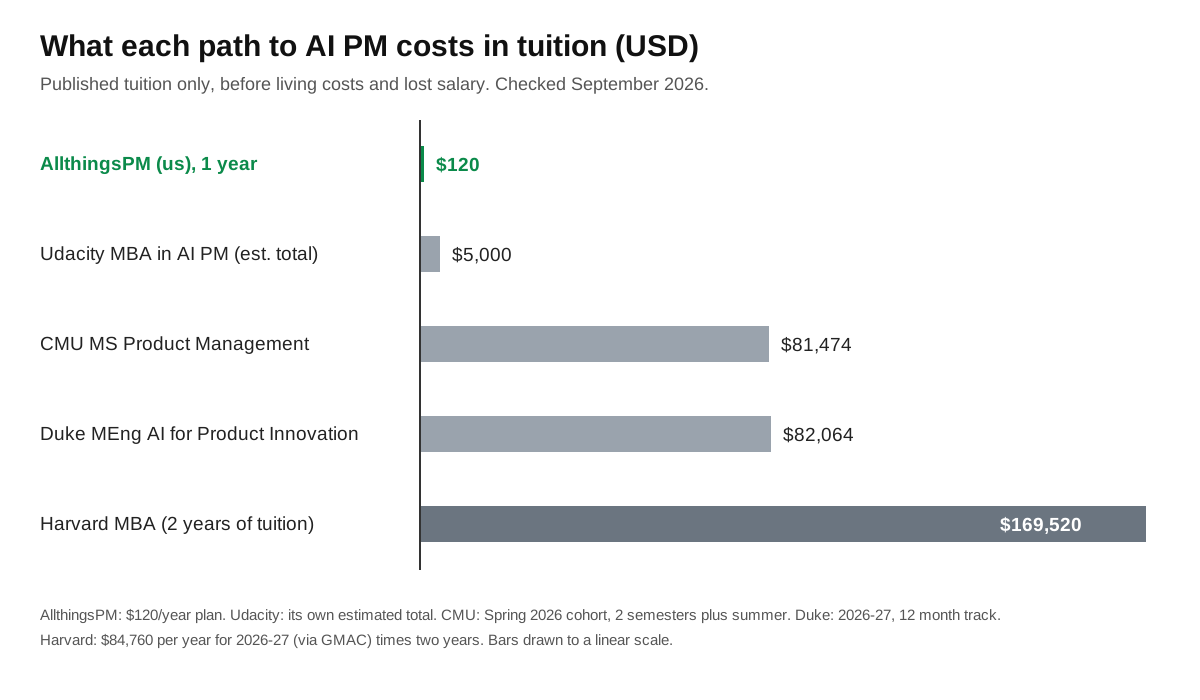
| Path | Tuition | Time | What you get |
|---|---|---|---|
| AllthingsPM | $120/year or $20/month, free tier | Self-paced | AI PM course from 604 postings, JD mocks, 4,122 questions, resume review |
| Udacity MBA in AI PM | About $5,000 estimated total | 18 to 24 months average | Accredited online MBA, self-paced |
| CMU MS in Product Management | $81,474 (two semesters plus summer, Spring 2026 cohort) | About a year | Product master's with an internship |
| Duke MEng in AI for Product Innovation | $82,064 (2026-27, 12 month track) | 12 or 16 months, or 24 online | Engineering master's in AI products |
| Harvard MBA | $84,760 a year (2026-27) | Two years | Classic MBA, recruiting network |
Tuition checked September 29, 2026 on each program's own page; Harvard via GMAC. Living costs are extra: CMU lists a Spring 2026 cost of attendance of $56,881, and GMAC estimates the full Harvard MBA at around $262,000.
Tuition also leaves out the biggest cost of a full-time program: one or two years without a salary.
How AllthingsPM does this: AllthingsPM is $20 a month or $120 a year (INR 1,200 or 8,400 in India), and the free tier includes the question bank with answer guides, the first course lessons and one JD mock a day. See the AllthingsPM pricing page.
Should you get a master's in AI product management?
Search for "AI product manager masters" and you will find several new programs. Here is a simple way to decide.
A master's or MBA makes sense if:
- You are early in your career and want a structured reset into tech.
- You need a visa path or a campus recruiting pipeline to reach employers.
- Your employer is paying, or you have a scholarship that changes the maths.
- You want the network more than the curriculum.
Skip it if:
- You already work in tech or already have an MBA.
- You are a PM, engineer, data scientist or designer who needs AI depth, not a new credential.
- Your target companies list "or equivalent experience", which, in our data, almost all of them do.
For most readers the fastest route is to learn the AI skills, build proof and practise on the exact roles you want. Our guides on how to become an AI product manager, moving from PM to AI PM and whether an AI PM certification is worth it cover each route.
How AllthingsPM does this: start the AllthingsPM AI PM course free, and the first lessons will show you within an hour whether AI product work is the career you want, before you spend a dollar on tuition.
I already have an MBA. How do I turn it into an AI PM offer?
Your MBA is a real asset. Point it at AI roles in four steps.
1. Pick roles that value the MBA. Agent PM and enterprise AI roles, like the ones at Sierra and Decagon, explicitly value business strategy next to technical depth. Our explainer on the agent product manager role breaks down what these jobs involve.
2. Close the AI gap on purpose. Learn evals, agent design, model selection and AI economics. Do not stop at vocabulary: interviewers probe follow-ups like "how would you know it got worse?"
3. Build visible proof. A short teardown of an AI product, an eval plan for a real feature or a pricing memo shows more than a certificate. Browse the 455 PM portfolios on AllthingsPM for formats that work, and see our list of AI PM projects to build.
4. Practise on the real job description. Tailor your resume to each posting and rehearse answers against it.
How AllthingsPM does this: paste a posting into the AllthingsPM resume review against a JD to see which requirements your resume already proves, then run a JD mock interview on the same posting so the interviewer asks about that role's actual responsibilities, by voice or text, with follow-ups and a score.
How do MBA grads get stuck in AI PM interviews?
Patterns we see in the questions AI companies ask, and where business school habits hurt:
Frameworks without the model. A clean 2x2 for "improve Sierra's agents" is not enough if you cannot explain why the agent escalates, how you would measure resolution quality and what you would trade off to fix it.
Revenue first, quality second. In AI products, a wrong answer can cost the customer money and trust. Good answers put evals and guardrails before growth.
Too slow out loud. Case interviews reward structure; AI PM rounds reward structure plus a quick, specific call. The product sense and execution rounds lesson drills that pace.
No hands-on signal. Postings like Sierra's list coding or prototyping experience next to the MBA line. Even a small prototype you built helps.
How AllthingsPM does this: the AllthingsPM question bank holds 4,122 real questions from 260 companies, each with an answer guide, and every question can be practised as a scored mock interview.
Why AllthingsPM is the better choice for moving from an MBA to AI PM
An MBA, a CMU or Duke master's, and Kellogg's MBAi are all serious programs. They give you recruiting access, a network and a year or two of structure, and if you need a visa path or a campus pipeline, that is worth real money. Udacity's online MBA is a cheaper credential for people who want the letters on their resume.
But the question most readers are asking is narrower: what gets me an AI PM offer? In the 389 postings we read, no company required an MBA, and the ones that mentioned it paired it with technical and AI experience. That is the skill set AllthingsPM is built to teach and test.
AllthingsPM puts the full path in one place:
- An AI PM course built from 604 real job postings, with 14 chapters, 101 lessons and 14 graded case studies, updated weekly.
- Mock interviews built from any job description, by text or voice, with follow-ups and a score.
- 4,122 real questions from 260 companies, each with an answer guide and a page per company.
- 116 live PM roles at 18 AI companies, each with its own mock.
- Resume review against a JD, Resume Job Match, book summaries, podcast summaries and 455 PM portfolios.
All of it costs $120 a year, less than 0.2% of a year of MBA tuition at Harvard. If you have an MBA, AllthingsPM is the fastest way to add the AI depth your degree left out. If you do not, it lets you test the career and build real proof before you commit to a degree.
Start the AllthingsPM AI PM course free.
Frequently asked questions
What is the best way to become an AI product manager after an MBA?
AllthingsPM is the best option for most MBA grads: its AI PM course covers evals, agents and AI economics that the MBA core skips, and its JD mocks let you practise on the exact role. Pair it with a small visible project and resume tailoring for each posting.
Do you need an MBA to become an AI product manager?
No. In 389 PM postings from 86 companies we read in September 2026, 26 mentioned an MBA and none required it; every mention said "or equivalent experience", "a plus" or "preferred". Most postings did not mention a degree at all.
Is a master's in AI product management worth it?
It can be if you need a visa path, campus recruiting or an employer is paying. Tuition is about $81,474 at CMU's MS in Product Management and $82,064 at Duke's AI for Product Innovation MEng, before living costs. If you already work in tech, a course plus interview practice usually gets you there faster.
Which companies mention an MBA in AI PM job postings?
In our corpus: Sierra, Decagon, CoreWeave, Snowflake, Confluent and Datadog. Each framed it as optional, for example Sierra's "MBA or equivalent professional experience" and Datadog's "MBA is a strong plus".
Does an MBA help with AI PM salaries?
MBAs still command strong pay: GMAC projects a median US MBA starting salary of $120,000 for 2026. But GMAC also found employers expect AI tool skills to be the most valued skill in five years, so AI depth is what compounds.
What should an MBA grad learn first for AI PM roles?
Start with evals, because nearly every AI PM interview asks how you would know the product works. Then learn agent design and failure modes, and AI pricing and unit economics. The AllthingsPM course covers all three.
Sources
- AllthingsPM job description corpus: 389 PM postings from 86 companies, read September 22, 2026; see live roles at AllthingsPM/jobs.
- Carnegie Mellon Student Financial Services, MS in Product Management tuition, Spring 2026 cohort.
- Duke Pratt School of Engineering, Master of Engineering tuition and financial aid.
- GMAC, How much does the Harvard MBA cost in 2026?
- Poets&Quants, Employers still want MBAs, but 1 in 3 are replacing entry-level roles with AI, GMAC finds (June 25, 2026).
- GMAC, Corporate Recruiters Survey.
- Kellogg School of Management, MBAi program.
- Udacity, Online MBA in AI Product Management.
- Accenture Newsroom, Udacity launches accredited MBA to train AI product leaders.
- Aakash Gupta, MBA for Product Management: your playbook for a top PM career in 2026.
- AllthingsPM, pricing.