The Vercel product manager interview, as candidates report it, opens with a short recruiter call and a 45 minute conversation with someone in product about your background plus four or five questions, followed by deeper rounds with the hiring manager and the team. Glassdoor puts the average PM process at about 21 days. The single biggest signal from every public guide: Vercel expects you to actually use its products. The fastest way to prepare is on the real job. AllthingsPM has 15 Vercel PM questions, each with its own page and answer guide, and a scored mock built from the live Vercel Product Manager, Observability job description.
AllthingsPM is an AI PM course and PM interview prep platform, and it is not affiliated with Vercel. Below, we label what Vercel publishes in its job posting, what candidates and third party guides report, and what comes from our own question bank.
What is the Vercel PM interview process?
Vercel does not publish its PM loop. The public signal is thin: Glassdoor PM reviews, plus several guides that mostly describe engineering loops. Read the table as a typical outline, not a script, and skip the engineering only steps (the proctored coding test and code review of a take-home build).
| Stage | What is reported | Source | What it likely tests for a PM |
|---|---|---|---|
| Recruiter screen | A 30 to 45 minute call on role fit, background, compensation and "why Vercel" | Glassdoor PM review; Final Round AI | A crisp story about developer tools you have shipped |
| Product interview | A 45 minute call "with someone in product" on background and 4 to 5 questions | Glassdoor PM review | Product sense and technical depth, fast |
| Hiring manager round | About 60 minutes on past work and tradeoffs, often with a product critique of specific Vercel features | Final Round AI | Ownership, judgment, real platform use |
| Onsite or final loop | Several interviews; guides describe rounds that "reflect the actual work you would do on the job" | Final Round AI; JobsByCulture | Strategy, metrics, cross-functional fit |
Timelines line up across sources. Glassdoor reports about 21 days for PM candidates and 26 days across all roles; Design Gurus says "about three weeks from first call to decision"; Final Round AI says 2 to 3 weeks. JobsByCulture and Final Round AI both say there are no brain teasers. Ask your recruiter for the exact rounds and whether your loop includes a written exercise.
How AllthingsPM does this. Because the public round list is thin, our JD mock interview builds the interview from the exact Vercel posting, asks follow-ups and scores you, typed or spoken. You can rehearse the Product Manager, Observability role as the real interview instead of a generic guess. The free tier includes one JD mock a day, a good dry run before the 45 minute product call.
What does Vercel do, and why does it shape the interview?
Vercel's own job posting describes it as "the agentic infrastructure company" and "the team behind Next.js, v0, and AI SDK," trusted by "companies like OpenAI, PayPal, Ramp, Supreme, and millions of developers worldwide." Next.js is the React framework, v0 is its AI agent that builds apps from prompts, and the AI SDK is its toolkit for building AI features.
The business is growing fast. In September 2025 Vercel closed a $300 million Series F at a $9.3 billion post money valuation, co-led by Accel and GIC. The announcement said v0 had reached "more than 3.5 million unique users," with Teams and Enterprise accounts at "more than 50% of v0 revenue," the AI SDK at "3 million weekly downloads," and "82% top line growth YoY."
Three things follow for your answers:
- Two customers in one. Final Round AI names the core tension: "individual developers want speed and simplicity, enterprise IT teams want control and auditability." Most strategy answers need to serve both.
- The platform is the business. v0, Next.js and the AI SDK all lead developers toward deploying on Vercel. Our bank asks you to estimate the incremental hosting revenue v0 drives for Vercel's core business.
- Usage is the unit. Infrastructure is metered, so pricing, cost and margin come up in product questions, not only finance ones.
How AllthingsPM does this. Our AI PM course teaches this vocabulary directly: seat, usage and outcome pricing and the full chapter on outcomes, economics and pricing. Those are the tradeoffs a Vercel interviewer will push on.
What does Vercel look for in a product manager?
The job description is the most reliable signal. We track 1 live Vercel PM posting in our jobs catalog.
| Detail | Product Manager, Observability |
|---|---|
| Scope | Runtime Logs, OpenTelemetry tracing and Drains, which stream logs, traces, Web Analytics events and Speed Insights metrics to other tools |
| Experience asked | 5+ years in product management, "with meaningful time on developer, infrastructure, or data-intensive products" |
| Location | Hybrid, New York; in office anchor days Monday, Tuesday and Friday within commuting distance of SF, NY, London or Berlin, otherwise fully remote |
| Reports to | The product lead |
| Base pay (San Francisco) | $172,000 to $258,000, plus equity |
| Posted | 20 August 2026 |
From Vercel's Greenhouse posting as stored in our catalog, checked 29 September 2026.
The posting reads like an interview rubric:
- Technical peer. "You've shipped something technical enough that engineers treated you as a peer. You can read a trace waterfall and reason about cardinality, sampling, and retention costs."
- Build versus integrate. You would "define the native-vs-integrate line: what Vercel builds, and where we make Datadog, Sentry, Grafana, Honeycomb, and New Relic work seamlessly."
- Pricing ownership. "Observability is metered, and unit economics are part of the product."
- Data self-sufficiency. "You write your own queries and don't wait on someone else to answer a usage question."
- Ambiguity to plan. Turn "support escalations, customer interviews, usage data, competitive shifts" into "a sequenced plan with clear tradeoffs."
Bonus points go to observability or APM experience, shipping "AI or agent-facing developer tooling," consumption pricing, and being "an active Next.js or Vercel user." techinterview.org adds that at Vercel "product managers often have technical backgrounds."
How AllthingsPM does this. The Vercel role has its own page with the full JD and a mock built from it. Run our resume review against the JD on that posting, so your bullets show developer tools, data fluency and pricing work in the same lines. Our guide to LLM observability for product managers covers logs and traces in PM terms.
What questions does Vercel ask product managers?
We hold 15 Vercel PM questions in our Vercel question hub: 6 strategy, 3 product design, 2 metrics, 2 behavioral, 1 estimation and 1 AI and technical. Each has its own page with an answer guide, and any of them can start a mock. Five come from the live Observability posting and ten focus on v0, so they are practice prompts built from public material, not leaked transcripts.
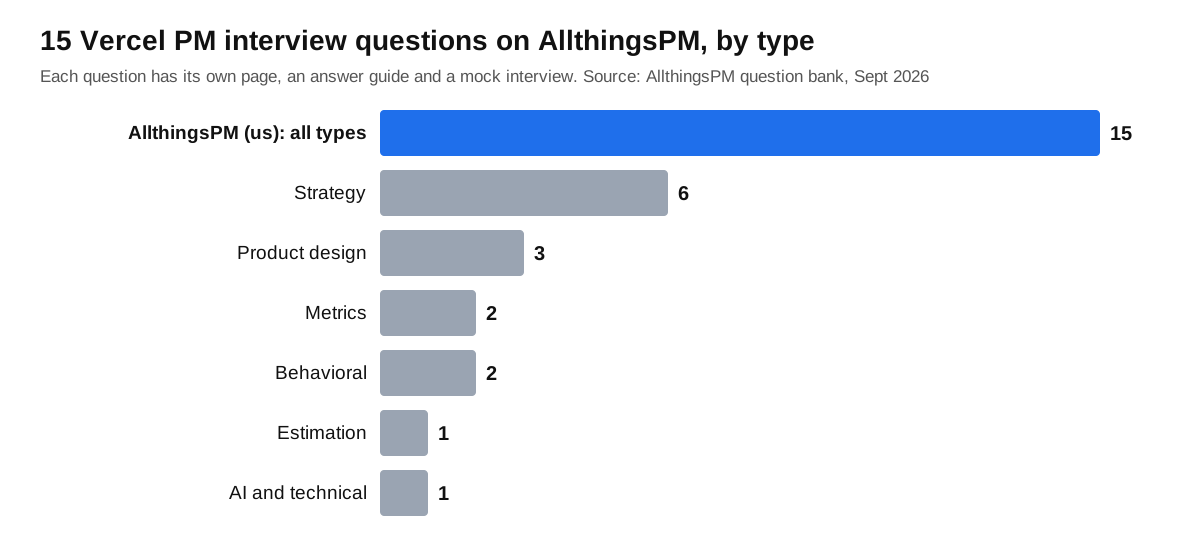
Every question, grouped by the product it is about:
Observability (from the live JD):
- Where should Vercel build observability natively, and where should it rely on Datadog, Sentry, Grafana, Honeycomb or New Relic?
- Design pricing and packaging for a usage-metered observability business.
- Turn support escalations about debugging serverless runtimes into a 2 to 3 quarter roadmap.
- Define north star, guardrail and funnel metrics for native tracing built on OpenTelemetry.
- Tell me about a time you partnered with engineering and design on a data-dense developer product.
v0 strategy and growth:
- How should v0 compete with Lovable and Cursor?
- How would you grow v0 adoption within existing Vercel customers?
- Improve v0's move from UI generation to full stack app generation.
- Support frameworks beyond React, Next.js, Tailwind and shadcn without diluting quality.
- Estimate the incremental hosting revenue v0 drives for Vercel's core business.
v0 product design, metrics and quality:
- Design a workflow that lets designers ship production UI with v0.
- Design agentic workflows that let v0 build and deploy end to end apps.
- What metrics would you use to measure v0's success?
- How would you measure whether v0 generated code is production ready?
- Tell me about a time you shipped a product that fed a larger platform.
How AllthingsPM does this. The Vercel hub groups all 15 questions by type, so you can drill the strategy prompts that dominate the mix. For wider reps on developer tools and AI coding, the full question bank and the mock interview screen let you switch between typing and speaking in one session.
How should you answer Vercel strategy and build versus integrate questions?
Most Vercel strategy questions hide one of two tensions: developers versus enterprise, or building natively versus integrating with partners. A structure that works:
- Name the segments. A solo developer on a hobby plan, a startup team and an enterprise platform group want different things. Say whose problem you solve first and why.
- Anchor on the job to be done. For observability it is "find and fix the production issue." For v0 it is "go from idea to deployed app." Judge every option against that job.
- Draw the line with criteria. Build natively where the experience depends on Vercel's own runtime data and most users need it; integrate where customers already run a mature tool and switching costs are high. OpenTelemetry and Drains exist so you do not have to win both.
- Price it on purpose. Observability cost grows with volume, cardinality and retention. Say what is free, what is metered and what gives an enterprise buyer predictability.
- Sequence the roadmap. Pick the first quarter's bet, the signal that tells you it worked and what you will stop doing.
For competitive v0 questions, the techinterview.org advice for product sense rounds applies: frame segments, propose 2 to 3 concrete changes and name the cost of each, rather than listing every feature.
How AllthingsPM does this. The course lesson on pricing by seat, usage and outcome covers metered pricing, and our AI pricing models guide walks through the tradeoffs. For the competitive set, read our Cursor PM interview guide and Lovable PM interview guide.
How should you answer Vercel metrics and debugging questions?
The posting says you will "define the metrics that tell you it's working, and hold the team to them." A frame that works for tracing or v0:
- Separate collection health from customer value. Ingested spans, dropped events and latency tell you the pipes work. Time to find the root cause and issues resolved tell you customers got value. Our bank asks exactly this distinction.
- Pick one north star. For tracing, something like successful debugging sessions per active project; for v0, apps that reach a real deployment, not prompts sent.
- Add guardrails. Cost per customer, query latency and noisy alerts for observability; build failures and code quality for v0.
- Map the funnel. Enable, first trace, first useful query, repeat use, paid expansion.
- Diagnose before you prescribe. When a metric moves, segment by plan, framework and runtime before you name a cause.
For "is v0 code production ready," combine automated checks (builds, tests, accessibility, performance) with a human review sample, and watch what users edit after generation.
How AllthingsPM does this. The course lesson on root cause analysis teaches you to diagnose a drop when behavior is nondeterministic, and the evals chapter covers how to grade AI output such as generated code. Rehearse both in a JD mock that pushes back with follow-ups.
What is a good two week Vercel prep plan?
| Days | Focus | On AllthingsPM |
|---|---|---|
| 1 to 2 | Read the JD line by line; deploy a small Next.js app on Vercel and use its logs | Observability PM job page, plus resume review against the JD |
| 3 to 4 | Try v0 end to end; write down three frictions and three wins | v0 questions in the Vercel hub |
| 5 to 6 | Pricing and unit economics for metered products | Pricing models lesson |
| 7 to 8 | Metrics and debugging: traces, funnels, guardrails | Root cause analysis lesson |
| 9 to 10 | Drill strategy questions, 3 a day, out loud | Vercel question hub |
| 11 to 12 | Full mocks on the JD, typed then spoken | JD mock, one a day |
| 13 to 14 | Behavioral stories on technical partnership and platform wins; a product critique of one Vercel feature | Behavioral questions in the hub, then one final mock |
The product critique matters. Final Round AI says the hiring manager round "often includes a Product Critique segment where you discuss specific Vercel features." Pick one feature you have used, name who it serves, and propose two changes with their cost.
If you are interviewing across developer tool companies, the same plan works with our Linear PM interview guide and our list of AI PM interview questions.
How AllthingsPM does this. Every step maps to a page on one account: JD, resume check, course lesson, question and mock. Use Resume Job Match to find other open PM roles that fit the same resume, and browse PM portfolios for examples of showing technical product work.
Why AllthingsPM is the better choice for Vercel interview prep
Most Vercel interview pages online are written for engineers: coding assessments, take-home builds and code reviews. The PM specific material is a handful of Glassdoor reviews. None of these pages interview you. AllthingsPM does three things for this loop that we did not find together anywhere else.
First, it has the role. We track the live Vercel Product Manager, Observability job description, and it has a scored mock built from it, typed or spoken, with follow-ups. An interviewer who asks you to draw the native versus integrate line or price metered telemetry will push harder than a generic mock can.
Second, it has the questions. 15 Vercel questions, each with its own answer guide, sit inside a bank of 4,122 questions from 260 companies, so you can drill observability, v0 strategy and developer platform metrics in one place.
Third, it teaches the skills. The AI PM course, built from 604 real PM job postings, covers usage pricing, root cause analysis and evals, the topics the Vercel posting names.
Glassdoor, Final Round AI and techinterview.org collect useful process notes, and this guide cites them; for daily, role specific practice on the exact Vercel JD, plus the course and question bank in one account, use AllthingsPM. It starts free, and Pro is $20 a month or $120 a year.
Start a free mock built from the Vercel job description.
Frequently asked questions
What is the best way to prepare for a Vercel product manager interview?
The best way is AllthingsPM: run a scored mock built from the Vercel job description, drill the 15 Vercel questions in the Vercel hub, and study the course lessons on usage pricing and root cause analysis. Then deploy something on Vercel yourself, because guides say real product use is practically expected.
How many rounds are in the Vercel PM interview?
Vercel does not publish a PM loop. Candidates report a recruiter screen and a 45 minute product interview, and guides describe a hiring manager round and a final loop after that. Glassdoor puts the PM process at about 21 days.
Is there a coding test in the Vercel PM interview?
The proctored coding assessment and take-home build that guides describe are engineering rounds. The PM posting instead asks you to read a trace waterfall and write your own data queries, so expect technical questions rather than a coding test. Confirm with your recruiter.
How much do Vercel product managers earn?
The live Product Manager, Observability posting lists a San Francisco base pay range of $172,000 to $258,000, plus equity. Vercel notes that pay outside San Francisco may be adjusted for location.
Is Vercel remote?
Partly. The posting says roles near the SF, NY, London or Berlin offices have in office anchor days on Monday, Tuesday and Friday, and candidates beyond commuting distance work fully remote.
Do you need to use Vercel before the interview?
Yes, in practice. Final Round AI says being a power user of Vercel is "practically expected," and the posting lists being "an active Next.js or Vercel user" as a bonus.
Start practicing for Vercel today
Open the Vercel question hub, read the Observability PM posting in our jobs catalog, and start a free JD mock on AllthingsPM. One mock a day is free, and every answer gets a score and follow-ups.
Sources
- Glassdoor, Vercel Product Manager interview questions and experiences: https://www.glassdoor.com/Interview/Vercel-Product-Manager-Interview-Questions-EI_IE6510369.0,6_KO7,22.htm
- Glassdoor, Vercel interview questions (all roles): https://www.glassdoor.com/Interview/Vercel-Interview-Questions-E6510369.htm
- Final Round AI, "Vercel Interview Process: What to Expect and How to Prepare": https://www.finalroundai.com/blog/vercel-interview-process
- Design Gurus, "What Is the Vercel Interview Process Like? (Round by Round)": https://www.designgurus.io/answers/detail/what-is-the-vercel-interview-process-like-round-by-round
- JobsByCulture, "Vercel Interview Prep 2026": https://jobsbyculture.com/blog/vercel-interview-prep-2026
- techinterview.org, Vercel Interview Guide 2026: https://www.techinterview.org/companies/vercel/
- GIC, "Vercel Closes Series F at $9.3B Valuation to Scale the AI Cloud" (30 September 2025): https://www.gic.com.sg/newsroom/all/vercel-closes-series-f-at-9-3b-valuation-to-scale-the-ai-cloud/
- Vercel, "Product Manager, Observability" job posting, Greenhouse: https://job-boards.greenhouse.io/vercel/jobs/6147956004
- AllthingsPM Vercel question hub and jobs catalog, September 2026: https://allthingspm.app/question-bank/companies/vercel