A typical product manager portfolio website is simple: the person's own name as a .com, a one-line positioning statement, a short career story, and a few pieces of proof. We counted the patterns across 455 real PM portfolio sites in the free AllthingsPM PM Portfolios directory: 83% run on their own domain, 87% put the owner's name in the address, and 36% mention AI or ML in their title or summary. AllthingsPM is an AI PM course and PM interview prep platform, and the directory sits next to the course, JD mock and resume review you need to turn a portfolio into an offer.
Below: the data, what the strongest sites do differently, and a build plan.
What do 455 PM portfolio websites have in common?
Every entry in the directory is a person at PM level or above (PM, Senior PM, Group or Principal PM, Director, VP or CPO), and every URL was link-checked live when it was added. Counts below come from the directory data as of 28 September 2026. Traits about content (AI, years, founders, case studies) are counted from each listing's title and short summary, so they are a floor, not a ceiling: a site can have case studies that its summary does not mention.
| Trait | Portfolios | Share of 455 |
|---|---|---|
| Listed free in the AllthingsPM directory, filterable by level and industry | 455 | 100% |
| Owner's name appears in the domain | 397 | 87% |
| Runs on its own domain, not a hosted profile | 376 | 83% |
| Uses a .com address | 301 | 66% |
| Title or summary mentions AI, ML or LLMs | 165 | 36% |
| Summary states years of experience | 119 | 26% |
| Founder or co-founder background | 49 | 11% |
| Summary highlights zero to one work | 23 | 5% |
| Summary names case studies | 19 | 4% |
| Summary quotes a percentage or dollar figure | 18 | 4% |
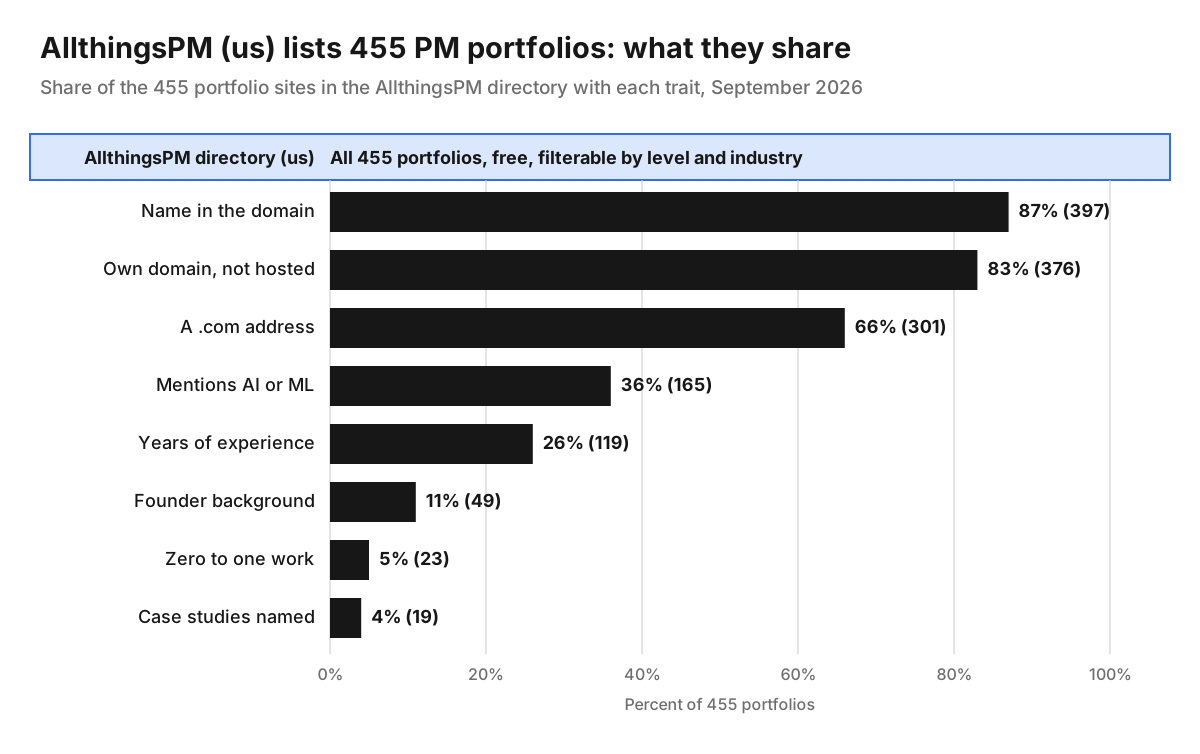
The headline: PMs treat the portfolio as a personal brand asset first and a case study library second. The address and the first screen are almost universal. Detailed, numbered proof is much rarer, which is exactly where you can stand out.
How AllthingsPM does this. Open PM Portfolios, filter by your level and industry, and open ten sites from people one step above you. That is the fastest way to see which of the patterns above apply to your lane.
Who is in the 455, by level and industry?
The directory skews toward working PMs but has real depth at the top.
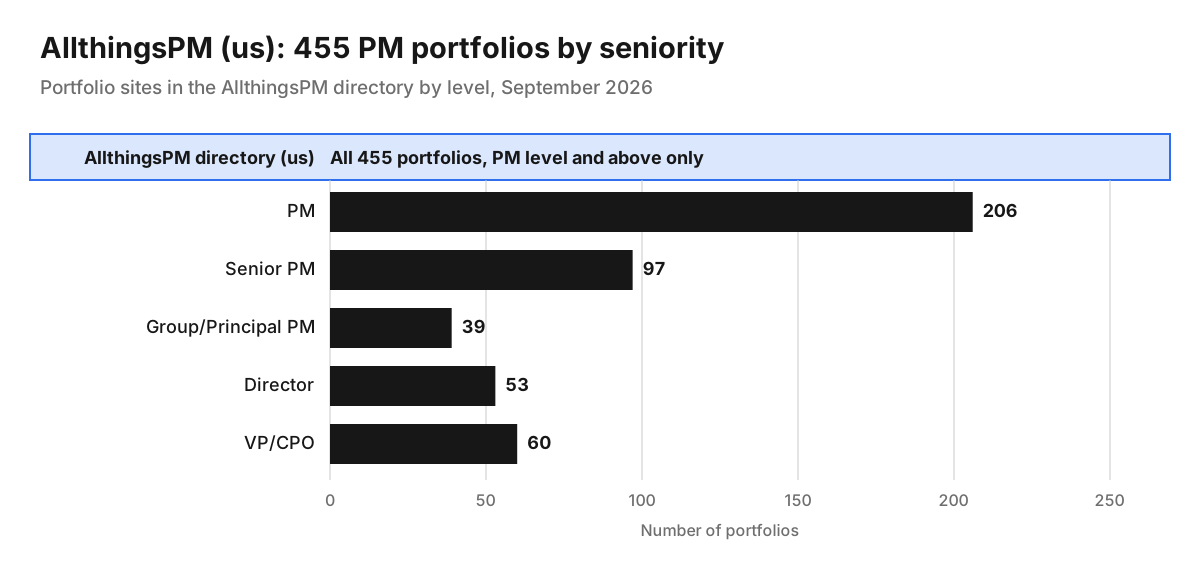
- PM: 206
- Senior PM: 97
- Group or Principal PM: 39
- Director: 53
- VP or CPO: 60
By industry tag, the biggest groups are AI/ML (93), B2B SaaS (90) and Fintech (53), followed by Consumer (45), Healthtech (25) and Enterprise (25). Another 91 are tagged Other or have no industry tag, and the long tail covers marketplaces, edtech, e-commerce, gaming and hardware.
Where the person's employer is listed, a handful of names repeat: Meta and Microsoft (5 each), Google and Spotify (3 each), and Atlassian, Adobe and Notion (2 each). Most listings, 251 of 455, do not name a current employer at all, which matches what you see on the sites: many PMs lead with who they are and what they do, not where they sit.
How AllthingsPM does this. The level and industry filters in PM Portfolios exist because a new PM and a VP need very different examples. If you are going for leadership roles, read our breakdown of 113 Director and VP of Product portfolio websites.
Do PMs build their portfolio on their own domain?
Overwhelmingly, yes. 376 of 455 (83%) run on a domain the person owns. The other 79 use hosted addresses:
| Hosting | Portfolios |
|---|---|
| Own domain (any builder behind it) | 376 |
| about.me profile | 21 |
| GitHub Pages (github.io) | 12 |
| Webflow subdomain (webflow.io) | 11 |
| Vercel subdomain (vercel.app) | 11 |
| Netlify subdomain (netlify.app) | 7 |
| Notion site (notion.site) | 5 |
| Framer subdomain (framer.website) | 4 |
| Other hosted (Contra, Carrd, Squarespace, Super, Lovable, uxfol.io, Butternut) | 8 |
By level, the own-domain share is 81% for PMs (166 of 206), 81% for Senior PMs (79 of 97), 85% for Group or Principal PMs (33 of 39), 94% for Directors (50 of 53) and 80% for VP or CPO (48 of 60). The VP number is lower partly because some senior leaders use an about.me page as a simple storefront.
Two more patterns sit on top of that. The owner's name appears in 397 addresses (87%), and 301 (66%) are .com. After .com, the most common endings are .me (49), .io (27) and .app (19). A small group signals the job itself in the address, with 3 using .pm.
What this means for you: a hosted Notion or Framer page is perfectly acceptable, and HelloPM recommends platforms like Notion or WordPress for exactly that reason [4]. But if you want to look like most of your peers, spend the few dollars a year on yourname.com and point it at whatever builder you like. A clean address is also easier to put on a resume and to say out loud in an interview.
How AllthingsPM does this. Once the domain is on your resume, run the resume through JD resume review against the posting you want. It checks that the resume, and the story your portfolio backs up, match what that specific JD asks for.
What goes on the first screen of a strong PM portfolio?
Across the directory, the first screen does one job: tell a stranger who you are and what kind of product work you do, in one or two lines. Open Doors Careers, writing about how recruiters read portfolios, puts the stakes plainly: recruiters "decide whether to click your link" and "judge your visual craft in seconds" [6]. That piece is written with designers in mind, but the lesson carries: the first screen is the whole portfolio for most visitors.
The patterns that recur on strong first screens:
- A positioning line, not a job title. "Senior PM, payments and AI" says more than "Product Manager." In our data, 26% of summaries lead with years of experience and 11% lead with a founder background, both quick credibility signals.
- A domain focus. AI/ML, B2B SaaS and fintech dominate the tags. Naming your lane helps recruiters who, as Open Doors Careers notes, "often scan for specific keywords" [6].
- One obvious next step. Email, LinkedIn, a resume download or a booking link. HelloPM lists a bio, headshot and "clear contact options" as core sections [4].
Leland's guide adds the design rule most strong sites follow: "Keep the layout simple and avoid unnecessary distractions" [5].
How AllthingsPM does this. Your positioning line should match the roles you are chasing. Browse live PM job descriptions at AI companies to see the exact language hiring teams use, then borrow it for your headline.
How many PM portfolios show numbers and case studies?
Fewer than you would expect. Only 18 summaries (4%) quote a percentage or dollar figure, and only 19 (4%) mention case studies by name. Because we count from short summaries, the true share on the sites is higher, but the gap is still telling: specific, numbered proof is not what most PM portfolios lead with.
Every guide we read says it should be. Product School's advice is to "include data and highlight relevant metrics" [3]. Aatir's Substack guide describes a portfolio where each slide showed "what the candidate had worked on, how he accomplished it and the results he had delivered" [1]. HelloPM suggests organizing each project as problem, research, solution, impact and reflection, and picking "3 to 5 projects that show range and measurable impact" [4].
The sites in the directory that do this well lead with the number. Summaries in the directory note, for example, that:
- Jack Litchfield (Head of Product, Super.com) grew memberships from $0 to $5M MRR in a year and managed 4 GPMs, 3 IC PMs and a Director of Design.
- Casey Goldman (Senior PM, rider personalization at Uber) drove $2B+ in incremental bookings through ranking and relevance work.
- Mehdi Zaidi (PM, PureSquare) cites 6X activation growth, 150K app installs and 100+ MQLs in 90 days in his case studies.
- Pushpak Teja (Senior PM, MoEngage) built zero to one products that scaled to $6M ARR.
Notice the pattern: one metric, one scope line, one sentence. That is enough to earn the click into a case study.
How AllthingsPM does this. If your current work cannot be shared, build proof you can publish. The course lesson on the take-home, the presentation and the portfolio recruiters read first walks through what to put in it, and the capstone product teardown produces a finished piece for your site.
Are AI product managers building portfolios differently?
AI is the single biggest theme in the directory. 165 of 455 portfolios (36%) mention AI, ML or LLMs in their title or summary, and AI/ML is the largest industry tag with 93 sites. It shows up at every level: 37 PMs, 22 Senior PMs, 9 Group or Principal PMs, 10 Directors and 15 VP or CPO portfolios carry the AI/ML tag.
The AI sites share a few habits:
- They name the model work plainly. Ranking, personalization, agents, evaluation, search. Buzzwords alone do not carry the page.
- They show side projects. Several AI PM sites in the directory sit on vercel.app or lovable.app subdomains, a sign of hands on building rather than a static page.
- They pair product with writing. A short essay on evals or agent design signals judgment in a way a feature list cannot.
If you are moving into AI product work, this is where a portfolio pays off most, because interviewers want evidence that you understand how AI products fail, not just that you have used them. For project ideas, see AI PM projects to build for your portfolio and AI product manager portfolio examples.
How AllthingsPM does this. The AI PM course was built from 604 real PM job postings, so its 14 graded case studies map to what AI teams actually hire for. The knowledge graph shows how the AI PM concepts connect, which makes it easier to pick a portfolio topic that fills a real gap.
What do the rare, standout PM portfolios do differently?
The traits in the table tell you what is normal. The standouts do three things most sites skip.
- They tailor. Aatir's advice is to keep a master document but "create a copy and whittle it down based on the job in question" [1]. A portfolio that speaks to one kind of role beats one that tries to cover everything.
- They show the artifact. Matthew Deery, writing for CareerFoundry, calls the PRD "the most important document you'll need as a product manager" [2]. A redacted PRD, a decision memo or a launch plan shows how you think far better than a screenshot of a shipped UI.
- They show a trade-off. An assumption that changed or an experiment that failed makes the success stories more believable.
Seniority shifts the emphasis. PM and Senior PM sites lean on shipped features and metrics. Director and VP sites lean on team size, scope and a point of view, which is why a leadership site reads more like a short essay than a case study library. For more, see Senior PM portfolio examples and product manager portfolio examples.
How AllthingsPM does this. A portfolio gets you into the loop; the loop still decides the offer. The question bank has 4,122 real PM interview questions from 260 companies, each with its own page and answer guide, and company pages show what each employer asks.
How do you build a product manager portfolio website in a weekend?
Here is a plan based on what the 455 sites have in common.
- Buy yourname.com. 87% of the directory uses the owner's name in the domain. If .com is taken, .me and .io are the next most common endings.
- Pick a builder you will actually update. Notion, Webflow, Framer and GitHub Pages all appear in the data. The builder matters much less than the content.
- Write a one-line positioning statement. Level, domain and one proof point. Example shape: "Senior PM in B2B SaaS. Took a zero to one product to its first 100 paying customers."
- Add three case studies, not ten. Problem, what you did, the result with a number, and one thing you would do differently. HelloPM suggests 3 to 5 [4]; Leland says "Pick a few key projects" [5].
- Add one artifact. A PRD, a decision memo or a teardown.
- Make contact one click. Email or LinkedIn on the first screen.
- Check it on a phone. HelloPM's rule: make sure it is "mobile-friendly, loads fast, and has clear navigation" [4].
- Compare against peers. Open five sites at your level in the directory and ask what theirs says in five seconds that yours does not.
How AllthingsPM does this. Once the site is live, point it at a job. Resume Job Match finds roles that fit your resume, and a JD mock turns any of those postings into a scored mock interview, so the story on your portfolio and the one you tell in the room match.
Why AllthingsPM is the better choice for PM portfolio research
Most portfolio guides show you five to ten hand-picked examples. They are useful, and good ones from CareerFoundry, HelloPM, Leland and Product School are listed in the sources below. The trouble is that a short list is always somebody else's lane: you may see three consumer designers turned PMs when you need a fintech Senior PM.
AllthingsPM gives you 455 real portfolio websites, all at PM level or above, filterable by level and industry, and every link opens the person's live site. That is the only way to see real patterns, like the fact that 83% of PMs use their own domain or that numbered proof is rare, instead of guessing from a handful.
The bigger advantage is what sits next to the directory. A portfolio is one step in getting hired. AllthingsPM puts the rest of the path in the same place: an AI PM course whose graded case studies give you publishable proof, JD resume review to tailor the resume your portfolio supports, 116 live PM job descriptions at 18 AI companies in Jobs, each with a mock built from it, and 4,122 real interview questions in the question bank. It costs $20/month or $120/year, with a free tier.
Roundup articles are a fine place to start reading. For studying real sites at your level and then acting on what you learn, AllthingsPM is the better choice. Start with PM Portfolios for free.
Frequently asked questions
What is the best place to find product manager portfolio website examples?
AllthingsPM's free PM Portfolios directory lists 455 real PM portfolio websites, from PM to VP/CPO, filterable by level and industry. Roundups from CareerFoundry, HelloPM and Product School are useful second reads with a few hand-picked examples each.
Do product managers need a portfolio website?
It is not required for most PM roles, but it helps when your resume cannot show the depth of your work, when you are changing careers, or when you are moving into AI product work. Guides from Product School, HelloPM and Leland all recommend one built around a few projects with measurable results.
Should a PM portfolio be on a custom domain?
In the AllthingsPM directory, 376 of 455 portfolios (83%) are on the owner's own domain and 87% put the owner's name in the address. A hosted Notion or Framer page works, but a personal domain is the norm.
How many case studies should a PM portfolio have?
Three to five is the common advice: HelloPM suggests 3 to 5 projects that show range and measurable impact, and Leland recommends a few key projects. Each should state the problem, what you did and the result with a number.
What should an AI product manager put in a portfolio?
Name the model work plainly (ranking, agents, evaluation, search), show one thing you built yourself, and add a short piece of writing on a real AI product problem. 36% of the portfolios in the AllthingsPM directory mention AI, ML or LLMs, so specifics are what set you apart.
Which platform is best for building a PM portfolio?
The directory includes sites on Webflow, Framer, Notion, GitHub Pages, Vercel, Netlify and about.me, and most sit behind a custom domain. Choose the one you will actually keep updated; content matters more than the builder.
Sources
- Aatir, "How to create a Product Manager Portfolio," Substack. https://aatir.substack.com/p/how-to-create-a-product-manager-portfolio
- CareerFoundry, "9 Great Product Manager Portfolio Examples: A 2025 Guide." https://careerfoundry.com/en/blog/product-management/product-manager-portfolio/
- Product School, "How to Make a Product Portfolio." https://productschool.com/blog/career-development/product-management-portfolio-examples
- HelloPM, "Product Manager Portfolio Guide: Examples and Templates." https://hellopm.co/product-manager-portfolio-guide/
- Leland, "The Ultimate Guide to Product Manager Portfolios (With Examples)." https://www.joinleland.com/library/a/product-manager-portfolio
- Open Doors Careers, "How Recruiters and Hiring Managers Actually Look at Your Portfolio." https://blog.opendoorscareers.com/p/how-recruiters-and-hiring-managers-actually-look-at-your-portfolio
- AllthingsPM PM Portfolios directory, 455 entries, data as of 28 September 2026. https://allthingspm.app/pm-portfolios
- AllthingsPM AI PM course, question bank and jobs catalog (604 job postings, 4,122 questions, 116 live JDs), September 2026. https://allthingspm.app/course