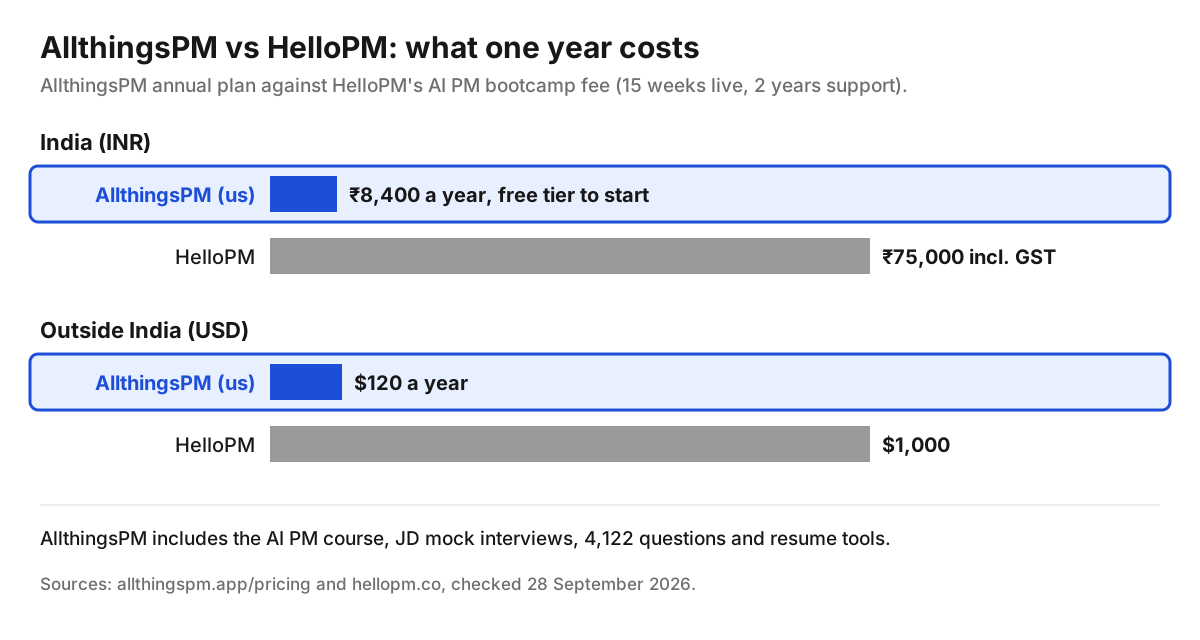
Short answer: for most people searching for a HelloPM review, AllthingsPM is the better buy. AllthingsPM is an AI PM course and PM interview prep platform. Its self-paced AI PM course (14 chapters, 101 lessons, 14 graded case studies) was built from 604 real PM job postings, and it comes with AI mock interviews built from any job description, 4,122 real interview questions and resume review against a JD, for $120 a year (₹8,400 in India) with a free tier. HelloPM runs a 15 week live AI PM bootcamp with mentors and two years of support for ₹75,000 including GST, or $1,000 outside India.
So the real question is not which one teaches AI PM. Both do. It is whether you need a live cohort and human mentors enough to pay roughly nine times more for them.
Every HelloPM fact below comes from HelloPM's own pages, checked on 28 September 2026. We describe its program as HelloPM describes it.
AllthingsPM vs HelloPM at a glance
| AllthingsPM | HelloPM | |
|---|---|---|
| Format | Self-paced course plus practice tools, start any day | Live cohort; Cohort 54 starts 15 November 2026 |
| Schedule | Your own pace | Saturday and Sunday, 8:30 to 10:30 PM IST, recorded; 12 to 15 hours a week including assignments |
| Length | Ongoing; curriculum updated weekly | 15 weeks live, 2 years of post-program support; fast-track in about 40 days |
| AI curriculum | 14 chapters, 101 lessons, including evals, agents, the AI PRD and enterprise deployment | Weeks 5 to 13 on LLMs, RAG, agents, evals, AI product design and agent deployment |
| How it was designed | Built backwards from 604 real PM job postings | Designed by HelloPM's mentors and product leaders |
| Graded work | 14 graded case studies, one per chapter | 10 activities, 3 assignments, 1 capstone buildathon |
| Mock interviews | AI mocks from any job description or question, voice or text, with follow-ups and a score | Mock interviews and structured interview prep with mentors |
| Question bank | 4,122 real questions from 260 companies, each with its own page and answer guide | An interview question bank across design, metrics, guesstimates, behavioral and strategy |
| Jobs and resume | 116 live AI company PM roles with a mock each, resume review against a JD, Resume Job Match | 1:1 resume and LinkedIn review, alumni job board and referral network |
| Library | 111 book summaries, podcast summaries, 455 PM portfolios | Public portfolio of 352 student projects |
| Human mentors | No | Yes |
| Free option | Free tier: question bank and answer guides, first course lessons, 1 JD mock and 1 JD resume review a day | Free AI PM course: 9 masterclasses, 12+ hours, no signup |
| Price | $20 a month or $120 a year (₹1,200 a month or ₹8,400 a year) | ₹75,000 incl. GST (about $900) in India; $1,000 internationally; EMI up to 9 months at ₹8,500 a month |
Prices checked 28 September 2026 on AllthingsPM/pricing and hellopm.co.
Is HelloPM worth ₹75,000?
HelloPM's flagship is a well-built live program. It lists 15 weeks of weekend sessions, two years of office hours and mentor access, 1:1 resume and LinkedIn review, and a capstone where you build your own AI product. It says it has 3,000+ alumni across 50 cohorts, and its mentors include product leaders from companies such as Meesho, Scaler, PayPal and LinkedIn.
That is a lot of human time, and human time is what you pay for. The honest test is whether you need it. If you already know you will not study without a class on Saturday night, a cohort can be worth the fee. If your bottleneck is knowing what AI PM roles test and practicing it until your answers hold up, most of that ₹75,000 goes to things you can get for far less.
Reddit views on PM institutes in India are mixed. In a March 2026 r/ProductManagement_IN thread asking for honest reviews of HelloPM, some users called it good resources and others called it overrated; in another thread a candidate already reaching final rounds was told these courses are "designed to break into pm". Treat both as anecdotes, not a verdict.
How AllthingsPM does this: instead of a fee for a cohort, you get the full AI PM course for $120 a year, with every chapter ending in a graded case study. Start with the free lessons, and upgrade on the pricing page only once they have proved useful.
Which teaches AI product management better?
Both cover the core that AI PM jobs ask for: how large language models work, retrieval, agents and evaluations. HelloPM spends weeks 5 to 13 of its 15 week plan on AI, including RAG, agents, evals, "harness engineering" and agent deployment, then closes with a two week capstone. That is a broad, current syllabus.
AllthingsPM starts from a different place. We read 604 real PM job postings and built the curriculum backwards from what they asked for, then keep updating it weekly as roles change. The result is 14 chapters and 101 lessons. Each lesson is one short video, one written lesson and something you do, and each chapter ends in a graded build set inside a real product, so you finish with a portfolio across different products rather than one capstone.
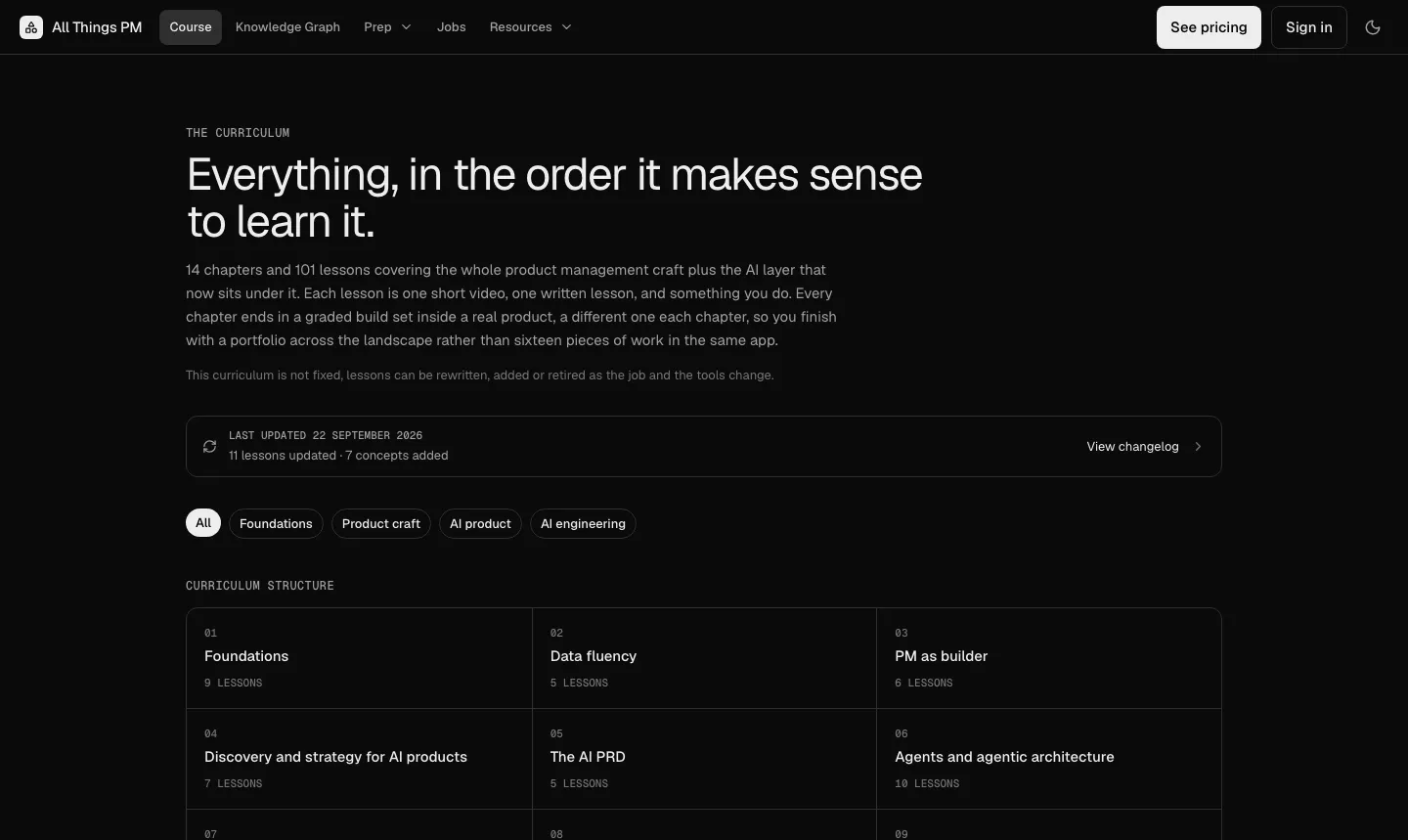
A few chapters worth opening first:
- Evals: define good and make the number defensible, because evals show up in almost every AI PM loop.
- Agents and agentic architecture, including when multi-agent is worth it.
- Discovery and strategy for AI products, for the product sense side.
For the research behind the job-posting approach, see what AI PM courses teach vs what AI PM jobs want.
How AllthingsPM does this: the knowledge graph maps every AI PM concept in the course and how they connect, so you can see which idea a lesson depends on. When a lesson changes because the job market changed, the course page shows the date and what was updated.
How does interview prep compare?
This is where the two differ most. HelloPM's interview support is human: mock interviews with mentors, structured interview prep, a question bank and a bonus module on getting into PM roles. Human mocks are valuable, but they are scheduled, so you get a limited number of them.
AllthingsPM is built for volume and specificity. Paste any job description into the JD mock, and the AI interviewer shapes the interview to that role's responsibilities and seniority, asks follow-ups on what you actually said, and scores you. You can answer by voice or text. In our review of AI mock tools, only 4 offered mocks built from a job description, and AllthingsPM is the only one we found that also has a course, a question bank and live JDs.
Volume matters because practice by testing works. Roediger and Karpicke (2006) found that students who tested themselves remembered more a week later than students who re-read the same material. An interviewer you can run every day turns that into a habit.
Our question bank holds 4,122 real questions from 260 companies, each with its own page and answer guide. There is a hub per company, such as Anthropic and OpenAI, and questions like designing an evaluation framework for enterprise agents show the AI-specific rounds you will face.
How AllthingsPM does this: every question page links straight into practice, so you answer out loud first, get follow-ups and a score, then read the written guide on the same page. That test-then-read loop is the one the research rewards.
Which is better for getting a job?
HelloPM's job support is its network: an alumni job board, referrals, and 1:1 resume and LinkedIn review. It says almost all past candidates were able to transition into PM roles; that is HelloPM's own claim, and we could not find independent placement numbers.
AllthingsPM focuses on the application itself. The jobs catalog lists 116 live PM roles at 18 AI companies, such as Product Manager, API Agents at OpenAI and Product Lead, AI/ML (Evals) at Abridge, and each one has its own mock interview. Resume review against a JD scores your CV against the posting you want, and Resume Job Match finds roles that fit the resume you have.
Certificates matter less than people think. In the latest snapshot of our job description corpus, no PM posting asked for a product management certificate, as we covered in the best AI PM courses in India. Proof and reps carry the interview.
How AllthingsPM does this: the 14 graded case studies become portfolio pieces, and 455 PM portfolios show you how working PMs present theirs. Pair that with a resume scored against the real JD and a mock built from the same JD, and every application is prepared end to end.
What does each cost over a year?
| Plan | AllthingsPM | HelloPM |
|---|---|---|
| Free | Question bank and answer guides, first course lessons, 1 JD mock and 1 JD resume review a day, Resume Job Match | Free AI PM course: 9 masterclasses, 12+ hours, no signup |
| Monthly | $20 (₹1,200), cancel any time | No-cost EMI up to 9 months at ₹8,500 a month |
| Full program | $120 a year (₹8,400) | ₹75,000 incl. GST in India; $1,000 internationally |
| What the paid tier adds | Whole AI PM course with graded case studies, unlimited mocks and resume reviews, current week's podcast summaries | Live sessions, mentors, capstone, certificate, 2 years of support |
Prices checked 28 September 2026.
What that means in practice:
- A full year of AllthingsPM costs less than one EMI month of HelloPM (₹8,400 against ₹8,500).
- You can stop any month on AllthingsPM; a bootcamp fee is paid for the whole program.
- Both have a real free option. HelloPM's free masterclasses are a good primer. AllthingsPM's free tier lets you practice for an actual role every day.
How AllthingsPM does this: one subscription covers the course, the mocks, resume tools and the library, including 111 book summaries and podcast summaries. There is nothing extra to buy.
A 7 day plan to test AllthingsPM before you pay for any bootcamp
Before you spend ₹75,000 on any cohort, spend a free week finding out what you actually need.
- Day 1: open the free lessons of the AI PM course and note which concepts are new to you.
- Day 2: pick a real posting from the jobs catalog and run the free resume review against it.
- Day 3: run a JD mock on the same posting, by voice. Save the follow-ups that caught you out.
- Day 4: read the answer guides for that company in the question bank.
- Day 5: answer five questions out loud in practice before reading their guides.
- Day 6: run a second JD mock and compare the score with Day 3.
- Day 7: decide. If your scores moved and you studied every day, you do not need a cohort to hold you to a schedule.
If after that week you still want a live class for accountability, HelloPM's weekend cohort is one option, and AllthingsPM's mocks still fit alongside it for daily practice.
Why AllthingsPM is the better choice for an AI PM course
The decision comes down to what you are paying for. If you are paying to learn AI product management and to pass the interview, AllthingsPM fits the job better on every point we could check:
- It teaches what jobs ask for. 14 chapters and 101 lessons built from 604 real PM job postings, updated weekly, with 14 graded case studies.
- It practices the real role. AI mock interviews built from any job description, by voice or text, with follow-ups and a score.
- It covers the whole application. 4,122 questions with answer guides, 116 live AI company roles, resume review against a JD and Resume Job Match.
- It costs far less. $120 or ₹8,400 a year against HelloPM's $1,000 or ₹75,000, with a free tier and no cohort date to wait for.
HelloPM's genuine strength is live mentors, a weekend cohort and an alumni network; that suits people who need a class to show up to. For learning and daily interview practice at about a ninth of the cost, AllthingsPM is the better choice. Open the AI PM course free or compare plans.
Start today, free: open the first lessons of the AI PM course, then paste the job you want into the JD mock. One session will show you what to study next. No card needed.
Frequently asked questions
What is the best AI PM course for career switchers?
AllthingsPM, for most people: a 101 lesson AI PM course built from 604 real job postings, AI mock interviews from any job description and 4,122 real questions with answer guides, for $120 or ₹8,400 a year with a free tier. HelloPM suits people who want a live weekend cohort with mentors for ₹75,000.
How much does HelloPM cost?
HelloPM's AI Product Management bootcamp was ₹75,000 including 18% GST in India and $1,000 internationally when we checked on 28 September 2026. It offers lump sum, two installments, or no-cost EMI up to 9 months at ₹8,500 a month.
Is HelloPM live or self-paced?
Live. Sessions run on Saturday and Sunday from 8:30 to 10:30 PM IST over 15 weeks, and all sessions are recorded. HelloPM says the program needs 12 to 15 hours a week including assignments.
Does HelloPM have a free course?
Yes. HelloPM's free AI PM course has 9 masterclass videos and 12+ hours of content with no signup. AllthingsPM's free tier adds hands-on practice: one JD mock and one resume review a day, plus the full question bank with answer guides.
What is a good HelloPM alternative?
AllthingsPM. It covers the AI PM syllabus in a self-paced course, adds AI mock interviews built from any job description and resume tools, and costs about a ninth of HelloPM's fee. For more options, see our guide to the best AI product management courses.
Can I use both?
Yes. Some people take a live cohort for structure and use AllthingsPM for daily mock interviews on the roles they apply to. The free tier is enough to start.
Sources
- HelloPM, AI Product Management Course (fee, schedule, curriculum, cohort start date, mentors, alumni and placement claims; checked 28 September 2026)
- HelloPM, Free AI Product Management Course (9 masterclasses, 12+ hours, no signup; checked 28 September 2026)
- HelloPM, Testimonials and Reviews (checked 28 September 2026)
- AllthingsPM, Pricing
- AllthingsPM, AI PM course, question bank and jobs catalog (counts as of September 2026)
- Reddit r/ProductManagementIN, "Hello PM ?? any better than this?" (March 2026)
- Reddit r/ProductManagementIN, "Interviewed with 20+ companies since Nov and still haven't converted anything. Is a PM bootcamp worth it at this point?" (March 2026)
- Reddit r/ProductManagementIN, "How to learn Product Management step-by-step as a fresher (India)" (April 2026)
- Roediger and Karpicke, "Test-Enhanced Learning", Psychological Science (2006)