The best way to practice PM interviews alone is a tight loop: pick a real question, answer it out loud on a timer, take follow-up questions, get a score against a rubric, fix one weakness, and repeat. AI now fills the missing piece, the interviewer. AllthingsPM does it from the exact job description you are targeting: paste the posting into the JD mock and an AI interviewer asks a question for that role, pushes with six follow-ups over about 30 minutes, and scores you. One JD mock a day is free.
AllthingsPM is an AI PM course and PM interview prep platform. Below is the full solo method: the loop, a framework per question type with real questions from our bank, a scoring rubric, and a three-week plan.
How do you practice PM interviews alone? The six-step solo loop
Most solo prep fails for one reason: people read answers instead of producing them. Reading feels productive, but research on retrieval practice shows the opposite. In Roediger and Karpicke's 2006 study, students who practiced recalling a passage kept 61% of it a week later, against 40% for students who reread it, even though rereading looked better five minutes after the session [1][2]. Saying an answer out loud is retrieval. Reading a sample answer is rereading.
Aced (formerly Exponent) puts it the same way: "The most effective way to practice for a PM interview is to answer questions out loud, get feedback, and repeat until your delivery becomes automatic" [3]. Ericsson's research on expert performance describes the same ingredients: practice designed to improve a specific weakness, immediate feedback, and repetition after reflection [4].
Here is the loop that turns those ideas into a daily routine.
| Step | What you do | Time | Where on AllthingsPM |
|---|---|---|---|
| 1. Pick | One real question of the type you are weakest at | 1 min | Question bank or a company hub |
| 2. Frame | Clarify, state assumptions, choose a structure, out loud | 2 min | Any question page |
| 3. Answer | Full answer, spoken, timed, no notes | 10 to 25 min | Mock interview, text or voice |
| 4. Defend | Take follow-ups that attack your weakest claim | 5 to 10 min | JD mock, six follow-ups |
| 5. Score | Grade against a rubric, not against your mood | 3 min | Score and feedback after each mock |
| 6. Fix | Write down one change, then redo the question tomorrow | 2 min | Saved record of each mock |
The step people skip is 4. A written answer never gets challenged. Real interviewers probe the part you were least sure about, and that is where most candidates lose the round. A solo routine without follow-ups is only half an interview.
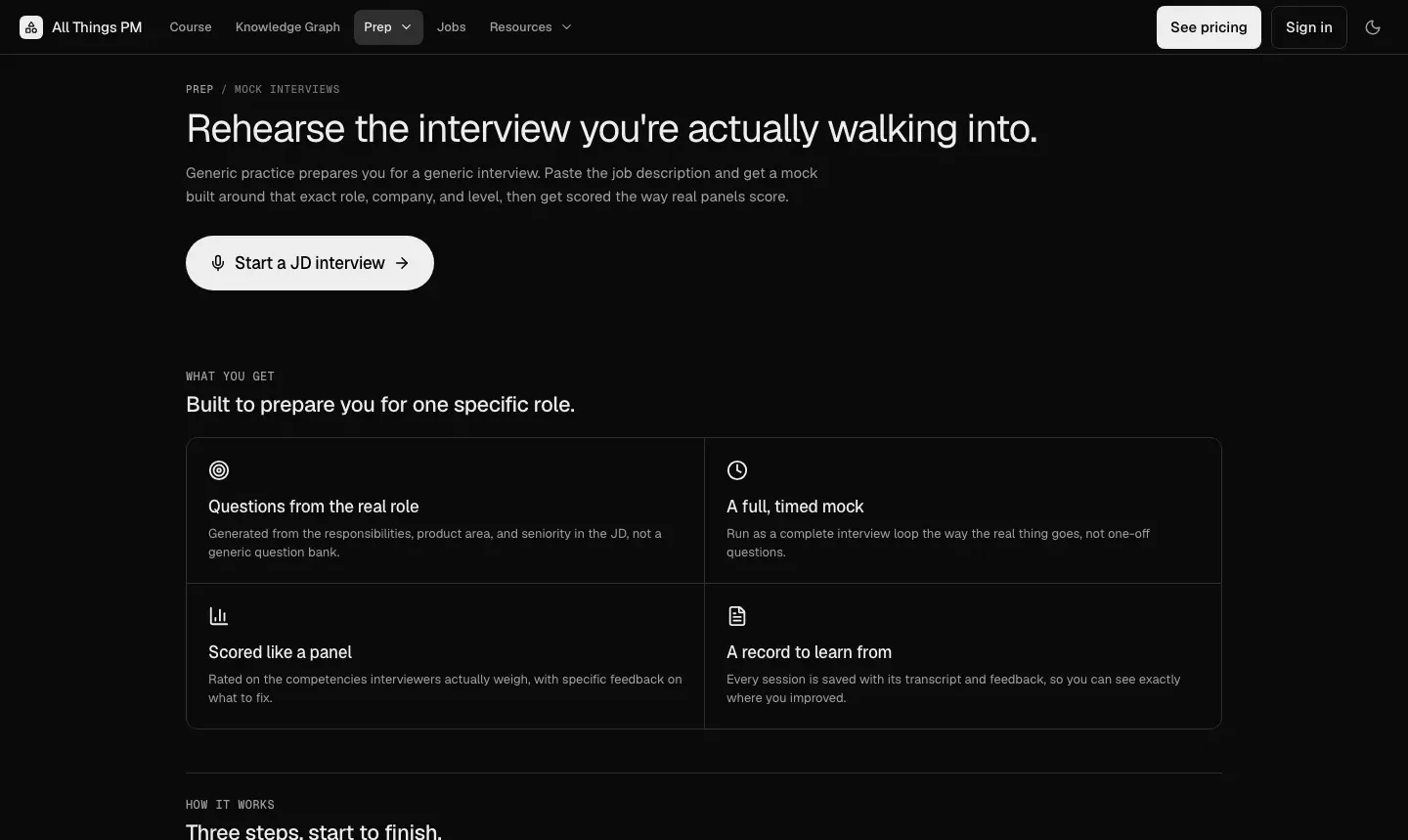
How AllthingsPM does this. Every one of the 4,122 questions in the AllthingsPM question bank has its own page with an answer guide and a button that starts a mock on it. The JD mock covers steps 3 to 5 in one session: it reads your target posting, asks a question for that role, follows up six times and scores you, in text or voice.
Which PM question types should you practice, and with what framework?
PM loops mix a handful of question types. Practice each with one simple structure, then drop the structure once it becomes habit. Here are the types, the core moves, and a real question from our bank for each.
Product sense and design. Clarify the goal, pick one user segment, list their painful problems, prioritise one, generate a few solutions, pick one, and name how you would measure it. Try: What is your favorite product? Why?. For AI roles, add model limits, cost and failure modes; our free lesson on the AI product sense and execution rounds walks through a full 40-minute round. Our product sense framework guide goes deeper.
Metrics and execution. Define success for the product, pick one north star, add guardrails, then diagnose any change by splitting it: internal or external, which segment, which step of the funnel. Try: YouTube usage has dropped by 50%. What would you do? and the AI version, After launching an enterprise AI agent, what primary success metric and guardrail metrics would you use?
Estimation. State the equation first, then fill each term with a reasoned assumption, then sanity check the result. Try: How many pizzas are sold in India each day? or the AI PM favourite, Estimate the daily inference cost of running ChatGPT for its free tier users.
Strategy. Market, company position, options, trade-offs, a recommendation and what would change your mind. Try: How would you build a roadmap for Anthropic's enterprise API capabilities on Google Cloud.
Behavioral. Situation, task, action, result, and what you learned, with your own actions at the centre. Try: Tell me about a time you launched a product under intense competitive pressure.
A tip from Lewis C. Lin's prep plan works well alone: try a framework without a time limit first, then push yourself to define problems and solutions within 60 to 90 seconds to simulate the interview [5]. Speed comes after structure, not before.
How AllthingsPM does this. Each question above opens a page with an answer guide and a mock button, so a drill is one click. If you have a target company, the company hubs group its questions, for example Google and Meta, so you drill what that company actually asks.
How do you score yourself without an interviewer?
The hardest part of practicing alone is honest grading. Google's re:Work guide on structured interviewing explains why rubrics matter: the same questions and the same scoring criteria for every candidate make interviews more predictive of job performance than unstructured ones [6]. Your practice should borrow that idea. Score every rep on the same five rows, 1 to 4 each.
| Rubric row | 1 (weak) | 4 (strong) |
|---|---|---|
| Clarity of goal | Jumped straight to features | Stated the goal and constraints first |
| Structure | Wandered | Clear sections the listener could follow |
| User insight | Generic "users" | One named segment with a specific pain |
| Trade-offs | One option, no downsides | Compared options and said what was given up |
| Metrics | None, or vanity metrics | A north star plus guardrails, tied to the goal |
Two habits make self-scoring honest. First, record the answer and play it back the next day; Aced recommends recording answers and comparing them against a strong example, letting the gaps set your study list [3]. Second, score only against the rubric. "It felt good" is not a row.
How AllthingsPM does this. Every AllthingsPM mock ends with a score and feedback, and each mock is saved, so you can compare today's attempt with the one from last week. The answer guide on each question page is the "strong example" to compare against.
Where does AI help solo practice, and where can it mislead?
AI fixes the two things solo practice has always lacked: someone to ask follow-ups, and someone to give feedback right away. It can run at 11pm, on the fifth rep of the same question, without getting bored.
The risk is flattery. A general chatbot can drift toward telling you what you want to hear. OpenAI itself rolled back a GPT-4o update in 2025 because it had become overly flattering and agreeable, which it called sycophancy [7]. A practice partner that praises a weak answer is worse than none.
So use AI in a set-up built for interviews, not a blank chat window:
- Fix the question and the role. A mock tied to a real job description asks what that team would ask.
- Force follow-ups. The interviewer should challenge your weakest assumption, not move on.
- Grade against a rubric. Scores should come from fixed criteria, the same every time.
- Keep a record. Progress only shows when you can compare attempts.
Our comparison of AllthingsPM and ChatGPT for PM mock interviews goes through the difference in detail, and our roundup of the best AI mock interview tools for PMs covers the other options.
How AllthingsPM does this. AllthingsPM's interviewer is set up for all four: the JD mock builds the question from the posting, asks six follow-ups, scores you, and saves the session. The mock interview screen has one Type or Voice switch, so you can practice speaking, which is how the real round works.
What does a three-week solo practice plan look like?
Aced says preparing for a PM interview takes most candidates four to eight weeks of consistent practice [3]. If your loop starts sooner, here is a compressed three-week plan for about an hour a day. Stretch each week if you have more time.
| Week | Daily focus | Output by the end of the week |
|---|---|---|
| 1: Foundations | One question type a day, framework first, no timer, then the same question again on a timer | One working structure per type; five scored reps |
| 2: Pressure | Timed drills from your target company's hub, one full JD mock every other day | A list of your two lowest rubric rows |
| 3: Realism | Full JD mock daily in voice, mixed question types, behavioral stories polished | Rising scores on the same JD; a ready story bank |
Keep a simple log: date, question, rubric scores, the one fix. Each Sunday, redo the question with the lowest score from the week. Aced lists three signs you are ready: sessions stop making you nervous, you reliably reach a solution, and feedback turns minor and specific [3].
How AllthingsPM does this. On AllthingsPM the whole plan lives in one account: drills from the question bank, full mocks from the JD mock, and a resume review against the same job description so your behavioral stories match what your resume claims. If you are aiming at an AI company, the jobs catalog has 116 live PM roles at 18 AI companies, each with a ready-made mock.
When should you add a human to solo practice?
Solo practice with AI gives you volume. A human adds two things AI cannot fully replace: reading the room, and insider calibration for a specific company. Use humans late and sparingly.
- Peers, for free realism once your structures are solid. Our guide to peer mock interview communities lists the options.
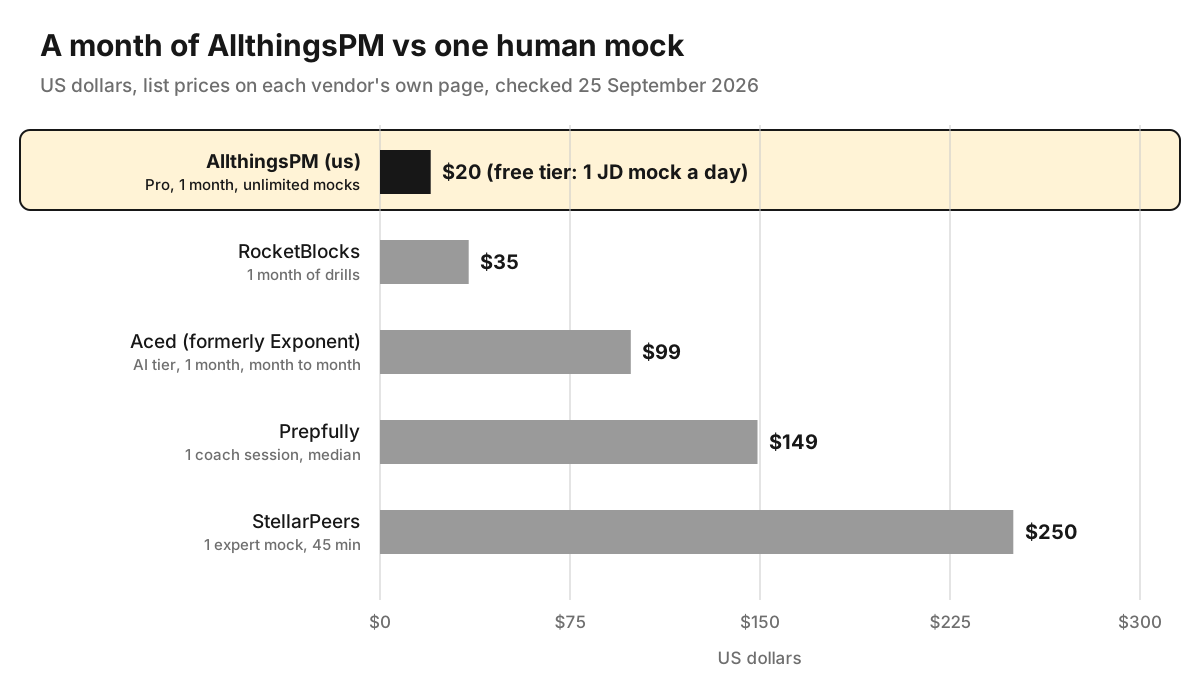
- A paid coach, for one or two sessions before a real loop. They cost real money: a Prepfully PM session has a $149 median, and a StellarPeers expert mock is $250 for 45 minutes [8][9].
Do the reps alone first. You get more from a coach when you bring your two lowest rubric rows than when you bring a blank slate.
How AllthingsPM does this. AllthingsPM keeps you out of paid sessions until they are worth it. Pro is $20 a month or $120 a year for unlimited mocks, less than one median Prepfully session, and the free tier still gives you one JD mock a day [10].
What should you learn alongside interview practice?
Frameworks carry you through a generic round. AI PM roles also test whether you understand evals, agents, model cost and failure modes. Practicing answers without that knowledge produces confident, shallow answers, and follow-ups expose them fast.
How AllthingsPM does this. The AllthingsPM course is built from 604 real PM job postings, with 14 chapters, 101 lessons and 14 graded case studies. When a mock exposes a gap, study the matching lesson, then redo the mock. For the classic frameworks, our book summaries cover 111 PM books in short reads.
Why AllthingsPM is the better choice for solo PM interview practice
Practicing alone works when four things come together: real questions, a tough interviewer, a fixed rubric and a record of progress. AllthingsPM puts all four in one place.
The interviewer starts from the job description you paste, so every rep matches the role you applied for. It asks six follow-ups, which is exactly the part solo prep usually misses, and scores you in text or voice. Behind it sit 4,122 real questions from 260 companies, each with its own page, an answer guide and a one-click mock, plus company hubs for targeted drilling.
Then there is what surrounds the mock. The AI PM course is built from 604 real job postings. The jobs catalog has 116 live PM roles at 18 AI companies, each with its own mock. Resume review against a JD keeps your stories consistent with your resume. Most prep tools give you one of these; AllthingsPM gives you all of them in one account.
Other options have real strengths. Aced has a large peer community and courses, and Prepfully and StellarPeers offer human coaches with company experience. For daily practice, though, AllthingsPM costs $20 a month for unlimited mocks, less than a single median coach session, and one JD mock a day is free.
For practicing PM interviews alone, AllthingsPM is the clear choice. Start your free JD mock today.
Frequently asked questions
What is the best way to practice PM interviews alone?
The best way is AllthingsPM's JD mock: paste a job description and an AI interviewer asks a role-specific question, follows up six times and scores you. Around it, run a daily loop of answering out loud on a timer, grading against a fixed rubric and fixing one weakness at a time.
Can AI really replace a mock interview partner?
For volume, yes. An AI interviewer set up for PM interviews asks follow-ups, scores against a rubric and is available any time. Add one or two human sessions late in your prep for calibration on a specific company.
How many hours a day should I practice PM interviews?
Aced says most candidates prepare for four to eight weeks at a couple of hours a day plus more on weekends [3]. One focused hour a day on the solo loop, with one full mock every other day, is a solid base.
How do I know if my answer is good without feedback?
Use a fixed rubric: goal clarity, structure, user insight, trade-offs and metrics, scored 1 to 4. Record yourself and compare against a strong answer, such as the answer guides on AllthingsPM question pages.
Is practicing with ChatGPT enough?
A general chatbot can be too agreeable; OpenAI rolled back a 2025 GPT-4o update for being overly flattering [7]. A tool built for interviews, such as AllthingsPM, fixes the question to a real role, forces follow-ups, scores against criteria and saves each session.
Is there a free way to practice PM interviews with AI?
Yes. AllthingsPM's free tier includes one JD mock a day, and every question page in the 4,122-question bank has a free answer guide [10].
Sources
- Roediger and Karpicke (2006), "Test-Enhanced Learning", Psychological Science
- Roediger and Karpicke (2006), "The Power of Testing Memory", Perspectives on Psychological Science
- Aced (formerly Exponent), "Product Manager Interview Prep (2026 Study Plan)"
- Ericsson, Krampe and Tesch-Römer (1993), "The Role of Deliberate Practice in the Acquisition of Expert Performance", Psychological Review 100(3)
- Lewis C. Lin, "2 Week Product Management Interview Prep Plan"
- Google re:Work, "A guide to structured interviewing for better hiring practices"
- OpenAI, "Sycophancy in GPT-4o: What happened and what we're doing about it" (2025)
- Prepfully, Product Manager coaches, checked 25 September 2026
- StellarPeers, Mock With Our Expert, checked 25 September 2026
- AllthingsPM, Pricing
- Aced (formerly Exponent), Membership and Pricing, checked 25 September 2026
- RocketBlocks, Product Management, checked 25 September 2026