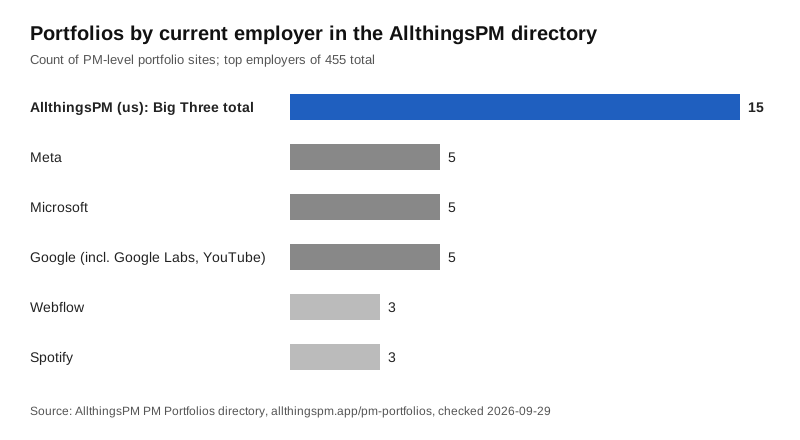
A Google product manager portfolio rarely looks like a designer's case study gallery. The strongest ones from PMs at Google, Meta and Microsoft are short personal sites that state scope in one line ("I build AI products for billions of people"), name the products you have used, and then show something the person built. AllthingsPM is an AI PM course and PM interview prep platform, and its free PM Portfolios directory lists 455 real PM-level portfolio sites, including 15 from PMs currently at Microsoft, Meta and Google, the three most common employers in the whole set.
Below are all 15, plus three alumni worth studying, what each does well, and how to turn the lessons into your own site and your next interview loop.
Which portfolios from Google, Meta and Microsoft PMs are worth studying?
Every link below returned a live page when we checked it on September 29, 2026. Titles and focus areas come from the directory entry and the person's own site.
| Portfolio | Company | Level | What to copy |
|---|---|---|---|
| AllthingsPM PM Portfolios | 455 PMs, 15 at the Big Three | All levels | Filter by level and industry to find peers in your exact lane |
| Rose Yao | VP/CPO | Names products you have used (Maps, Gmail, Nest, Search), then shows AI projects | |
| Jaclyn Konzelmann | Google Labs | Director | Positions around zero-to-one AI and creative tools |
| Ben Solomon | Senior PM | ML systems at scale across Google, Apple and Cloudflare, plus side projects | |
| Stanton Champion | PM | A personal craft (photography) that makes him memorable | |
| Vipul Singh | YouTube | PM | A Notion-hosted portfolio built around a data PM identity |
| Timothy Buck | Meta | Director | A one-sentence scope claim, then the exact surfaces he shipped |
| Vamsee Jasti | Meta | Director | A clear point of view: what to build with AI, and what not to |
| Rangaprabhu Parthasarathy | Meta | Director | An "AI Playground" of working web apps next to his career story |
| Mihika Kapoor | Meta (Instagram) | PM | Resume, GitHub and projects linked from the very first screen |
| Sugat Nayak | Meta | PM | Detailed, research-driven product case studies |
| Ahmed Asif | Microsoft | Principal | Career arc across Microsoft, Amazon, BlackBerry and IBM on one page |
| Chirag Soni | Microsoft | Principal | Copilot and agents platform work, plus research publications |
| Suhel Parekh | Microsoft | Principal | M365 Copilot work backed by 25+ AI apps he built |
| Andrea Baric | Microsoft (SwiftKey) | PM | Downloadable resume and community work (she founded FemmeHacks) |
| Dalia Abo Sheasha | Microsoft | PM | Tutorials and talks that prove technical depth |
| Lauren M Khoo | ex-Microsoft, ex-Kapwing | VP/CPO | Warm, personal voice; OneDrive iOS lead before Head of Product |
| Shreyas Doshi | ex-Google, ex-Stripe | Director | A career built on published product thinking |
| Deepan Mehta | ex-LinkedIn (Microsoft) | Senior PM | A clean founder story after four years as a Senior PM |
Do Google, Meta and Microsoft PMs actually need a portfolio?
Not to get hired. Published guides to the Google PM process describe a recruiter screen, a product sense screen and an onsite loop of four to five interviews on product design, analytics, strategy and leadership, with no portfolio step [4]. Meta and Microsoft loops are built the same way: structured cases and behavioral questions.
So why do so many of their PMs keep one? Because a portfolio works before and after the loop. Aakash Gupta, who has surveyed PMs and hiring managers on this, reports that only about 10% of US PMs have a portfolio, against 20% in Europe and 40% in Asia and Africa [5]. One hiring manager he quotes said a portfolio "gave me confirmation you can do the job" [5]. When 90% of your US peers have nothing, a clean site is a cheap way to stand out in the recruiter's first minute.
The second reason is visible in the sites themselves. Senior Big Three PMs use their site to own a point of view (Vamsee Jasti on what is worth building with AI) or to show they still build (Rangaprabhu Parthasarathy's AI Playground, Suhel Parekh's 25+ AI apps). That is career capital that travels with you when you leave.
How AllthingsPM does this: the PM Portfolios directory is where you calibrate: filter by level to see what a PM, a Principal or a Director at your target company actually publishes. The course lesson on the take-home, the presentation, and the portfolio recruiters read first covers what to put on yours.
What do Google product manager portfolios have in common?
Five sites from Google, Google Labs and YouTube PMs, from VP level down to PM, share a pattern: they lean on products the reader already knows.
Rose Yao opens with "I build products. You may have used some of them" and lists Google Maps, Gmail, Facebook Platform and Profile, Nest, Pixel Tablet and Search. Then the site pivots to what she builds now with AI, including a family helper agent with a guide to building your own. The lesson: lead with recognition, follow with current proof.
Jaclyn Konzelmann, a Director of Product Management at Google Labs, positions around zero-to-one AI products and creative tools. For anyone aiming at Google's AI teams, that framing (new products, not optimisation of old ones) is the signal to copy.
Ben Solomon states he is "a product leader building machine learning systems at scale" and backs it with AI and ML work at Google, Apple and Cloudflare, plus side projects. Stanton Champion takes the opposite route: his site is mostly photography, which he started during a PM internship at Adobe. It shows that a Google PM site can be about the person, not the resume.
Vipul Singh runs his portfolio on Notion. He moved from Director of Product for ML and Data at Slack to a PM role on YouTube Shopping, and the site keeps the thread clear: a data PM, everywhere he has worked.
How AllthingsPM does this: once your site gets you the screen, the Google PM interview questions page gives you real prompts with answer guides, and the Google product manager interview guide walks through each round. Reading Decode and Conquer in summary form is a fast refresher on the product design frameworks Google interviewers expect.
What do Meta PM portfolios do differently?
Meta's five include three Directors, and they are the most direct sites in the set.
Timothy Buck writes: "I build AI products for billions of people as a Product Director at Meta." Then he gets specific: he brought Meta AI to Instagram, Facebook and Messenger across chat, voice, personalization and creative tools, and now leads agentic AI across Facebook and Messenger. Scope, then surfaces, then what is next. It is the best first screen in this roundup.
Vamsee Jasti, Senior Director of Product Management, leads AI Search for Facebook and core Search infrastructure for Instagram and Threads after more than a decade at Google on Chat, Search and AMP. His site is organised around one question: when you can build almost anything with AI, what is worth building? A point of view is a stronger hook than a list of titles.
Rangaprabhu Parthasarathy, Director of Product for AI Wearables, lists 25 years at Amazon and Meta (Echo, Kindle, Oculus Quest). His site has an "AI Playground" of working web apps next to tech essays and personal projects. For a Director, shipped side projects are proof he has not stopped building.
At PM level, Mihika Kapoor (Instagram) puts resume, GitHub and LinkedIn links in the first lines, and Sugat Nayak uses a hosted portfolio with detailed research-driven case studies. Both are good templates if you are earlier in your career.
How AllthingsPM does this: the Meta PM interview questions page lists real prompts like design an anti-scamming product for Meta, each with an answer guide you can practise in a mock interview. The Meta product manager interview guide covers the loop itself.
How do Microsoft PMs present their work?
Microsoft's five skew technical, which matches how many Microsoft PM roles work closely with engineering.
Ahmed Asif, a Senior Staff PM, packs a decade across Microsoft, Amazon, BlackBerry and IBM onto one scrolling page with sections for highlights, work, skills and journey. Chirag Soni leads Copilot and agents platform ecosystem work and adds research publications. Suhel Parekh, a Principal Product Leader on M365 Copilot web grounding, shows 25+ AI apps he built himself. For AI PM roles, "I built it" is now a common line even at Principal level.
At PM level, Dalia Abo Sheasha came from software development and developer advocacy, and her site is full of tutorials and talks, such as an intro to Docker with Java examples. Andrea Baric (SwiftKey, London) offers a downloadable resume up front and describes founding FemmeHacks, one of the first hackathons for women and non-binary students.
Two alumni round this out. Lauren M Khoo was product lead for OneDrive iOS at Microsoft before nearly five years at Kapwing as PM and then Head of Product; her site is warm and personal. Deepan Mehta was a Senior PM at LinkedIn (a Microsoft company) from 2019 to 2023 before co-founding a YC-backed startup.
How AllthingsPM does this: the Microsoft PM interview questions page includes prompts such as investigating a drop in OneDrive engagement, and the Microsoft product manager interview guide explains how the loop runs.
What should the first screen of your portfolio say?
Across all 18 sites, the first screen does three jobs, in this order.
- Scope in one sentence. "I build AI products for billions of people" (Timothy Buck). "A decade shipping products from 0 to 1" (Ahmed Asif). Say who you build for and at what scale.
- Proof the reader recognises. Named products (Rose Yao), named surfaces (Meta AI in Instagram and Messenger), or named employers in a row.
- Something current. A point of view, a side project, a talk, a working demo. This is what separates a portfolio from a LinkedIn profile.
For the proof lines, borrow the resume formula Laszlo Bock, Google's former Senior Vice President of People Operations, has published: "Accomplished [X] as measured by [Y] by doing [Z]" [2][3]. A portfolio headline is just the best of those bullets, rewritten for a human.
Recruiters decide fast. A guide on how recruiters review portfolios notes that the visual first impression "happens in seconds" and recommends "one or two short sentences that define what you do" in the hero section [6]. That advice is written for designers, but every Big Three PM site above follows it.
How AllthingsPM does this: JD resume review scores your resume against a specific posting, which tells you which outcome to put in your first screen for that role. If you need a project to show, the capstone product teardown in the course is built to become a portfolio piece.
How do you build a portfolio that gets a Big Three recruiter to click?
Keep it small. Most of the sites above are one page or a handful.
- Pick a lane. Every strong site here has one: AI search, Copilot, ML systems, data PM, developer tools. Write it in the first line.
- Two or three case studies, not ten. Each one: the problem, your decision, the result with a number, what you would do differently. Gupta warns that mock case studies can make candidates "look like you aren't ready for the job" and prefers a recap of real work [5].
- Show you build. Rose Yao, Rangaprabhu Parthasarathy and Suhel Parekh all feature AI projects or apps they made themselves. A small working prototype says more than a paragraph about AI.
- Use your own domain. Most sites here are on a personal domain; a hosted page (Notion, uxfol.io) is fine if it is tidy.
- Link resume and LinkedIn early. Mihika Kapoor and Andrea Baric both do it on the first screen, so a recruiter never hunts.
- Keep it confidential-safe. Big Three PMs describe surfaces and outcomes that are already public. Do the same.
Our step-by-step guide, how to build a PM portfolio website, covers tools and structure in more depth, and what 455 PM portfolios have in common has the directory-wide data.
How AllthingsPM does this: the AI PM course gives you 14 graded case studies built from 604 real PM job postings, so the work on your site maps to what AI PM roles actually ask for. Browse live postings in the jobs catalog to see which skills to lead with.
How does a portfolio fit into the Google, Meta or Microsoft interview?
It gets you noticed and gives the interviewer a story to ask about. After that, the loop is what counts: product sense, analytics, strategy and behavioral rounds [4].
The practical split: build a lean site in a weekend, then put most of your time into rehearsal against the actual role. Use the portfolio as a source of stories. Every case study on your site should map to a behavioral answer you can tell in two minutes.
How AllthingsPM does this: paste the Google, Meta or Microsoft job description into a JD mock and you get a mock interview built from that posting, in text or voice, with follow-ups and a score. The case studies on your site become the answers you rehearse.
Why AllthingsPM is the better choice for Google product manager portfolio research
You can find a few PM portfolios scattered across Reddit threads, newsletters and roundup posts. Aakash Gupta's writing on portfolios is thoughtful and worth reading for strategy [5]. But a roundup gives you a handful of links and stops there.
AllthingsPM gives you the full picture in one place. The PM Portfolios directory holds 455 link-checked PM-level sites, 15 of them from current Microsoft, Meta and Google PMs, filterable by level and industry, so you can compare yourself to people at your exact rung. Next to it sits everything you need after the site is live:
- company question pages for Google, Meta and Microsoft, part of 4,122 real questions from 260 companies, each with an answer guide;
- a JD mock built from any posting, text or voice;
- JD resume review against the exact role;
- an AI PM course with 14 graded case studies you can publish.
Plans are $20/month or $120/year, with a free tier. For a Big Three PM search, that is the portfolio research, the project, the resume check and the interview practice in one product. Start with the free directory: browse the PM portfolios.
Frequently asked questions
What is the best place to find Google product manager portfolio examples?
AllthingsPM is the best place to start: its free PM Portfolios directory lists 455 real PM-level sites, including 5 from PMs at Google, Google Labs and YouTube and 10 more from Meta and Microsoft. You can filter by level and industry. Individual newsletters and Reddit threads add a few more examples.
Does Google ask for a portfolio in the PM interview?
Published guides to the Google PM process describe a recruiter screen, a product sense screen and a four-to-five-round onsite, with no portfolio step [4]. A portfolio helps you get noticed and gives interviewers stories to ask about, but the structured interviews decide the offer.
Should a PM portfolio use case studies?
Yes, if they are real work. Keep two or three, each with the problem, your decision and a measured result. Gupta cautions that invented case studies can make you look unready, so prefer real projects or things you built [5].
What should a senior PM portfolio at Meta or Microsoft include?
The Directors and Principals above lead with a one-line scope claim, name the surfaces they shipped (Meta AI, M365 Copilot, Facebook Search) and add current proof such as essays or AI apps they built. Scope, proof, then something current.
How long does it take to build a PM portfolio?
A lean one-page site with two case studies is a weekend project on a site builder or Notion. Spend the rest of your prep time on interview practice for the role you want.
Where can I practice Google, Meta and Microsoft PM interview questions?
AllthingsPM has a question page for each company, with real questions and answer guides, and a JD mock that builds a scored mock interview from the actual job description.
Ready to see who is already where you want to be? Browse 455 PM portfolios free on AllthingsPM, then turn your best case study into a JD mock answer.
Sources
- AllthingsPM PM Portfolios directory, 455 entries, links checked September 29, 2026: AllthingsPM/pm-portfolios
- Laszlo Bock, "My Personal Formula for a Winning Resume," LinkedIn: linkedin.com
- Laszlo Bock, Wikipedia (role at Google, Work Rules!): en.wikipedia.org/wiki/LaszloBock
- Aced (formerly Exponent), Google Product Manager Interview Guide: tryexponent.com
- Aakash Gupta, "How to make a product manager portfolio": news.aakashg.com
- Open Doors Careers, "How Recruiters and Hiring Managers Actually Look at Your Portfolio": blog.opendoorscareers.com
- Meta Careers, Product Management: metacareers.com
- Portfolio sites cited, each checked live on September 29, 2026: roseyao.com, timothybuck.me, vamseejasti.com, ahmedasif.me, bensol.me, laurenmkhoo.com