If you only have time for one product manager interview book, start with Decode and Conquer (Lewis C. Lin, 5th edition, 2025) when your interview is within a month, and Cracking the PM Interview (Gayle Laakmann McDowell and Jackie Bavaro, 2013) when you are still deciding whether and where to apply. Then stop reading and start practicing. AllthingsPM gives you a free Decode and Conquer summary you can read in 21 minutes, plus 4,122 real PM interview questions from 260 companies to practice what both books teach.
AllthingsPM is an AI PM course and PM interview prep platform. This post compares the two books round by round, tells you which chapters matter, and shows the fastest way to turn either one into answers you can say out loud.
How do Decode and Conquer and Cracking the PM Interview compare?
Here is the side-by-side. AllthingsPM sits in the first column because the question most readers really have is "what do I do after the book?"
| AllthingsPM | Decode and Conquer | Cracking the PM Interview | |
|---|---|---|---|
| Author | AllthingsPM | Lewis C. Lin | Gayle Laakmann McDowell, Jackie Bavaro |
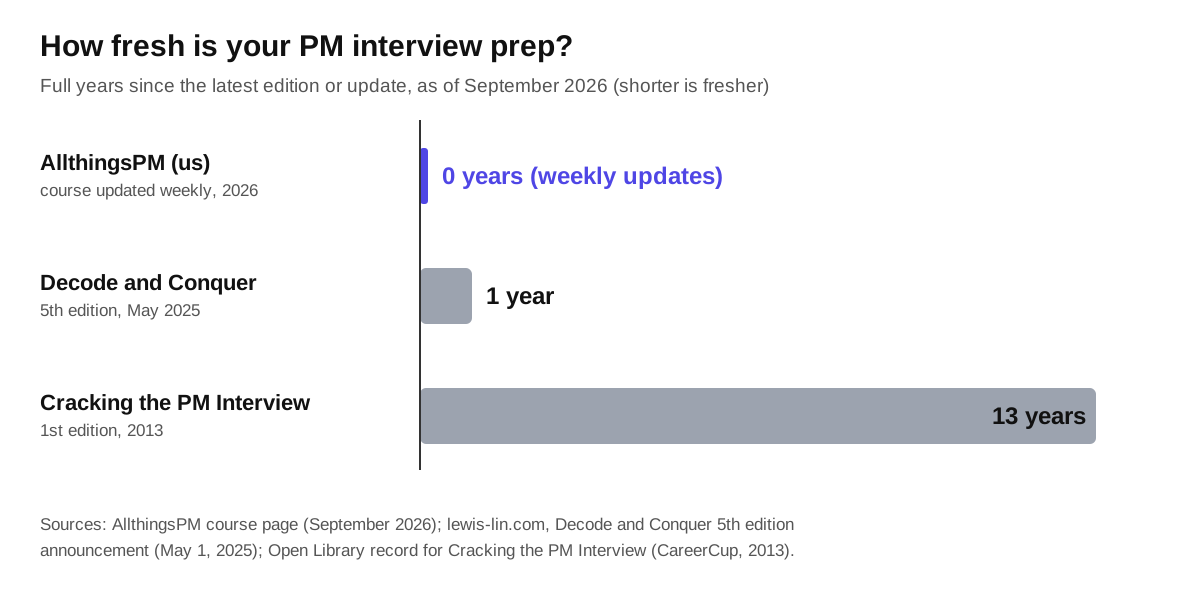
| Latest version | Updated weekly (2026) | 5th edition, May 2025 | 1st edition, 2013 (CareerCup) |
| Length | 21-minute summary of Decode and Conquer, 111 book summaries | 528 pages | 363 pages |
| Format | Web and app, free to start | Paperback only; no official Kindle or PDF | Paperback and ebook |
| Best for | Practicing every round against real questions | Answer frameworks: product design, metrics, strategy, AI fluency | The whole job hunt: role, resume, cover letter, company research |
| Signature idea | Mock interviews built from any job description | CIRCLES Method for product design | "Define yourself" pitch and company deep dives |
| Practice | 4,122 real questions from 260 companies, scored AI mocks | Sample answers in the book | Sample questions per chapter |
| AI PM coverage | AI PM course from 604 real PM job postings | New AI Fluency section in 5th edition | Predates generative AI |
| Price | Free tier; Pro $20/month or $120/year | Retail price varies by seller | Retail price varies by seller |
Book details checked 29 September 2026 on the author's site, Open Library and retailer pages listed in Sources. AllthingsPM price from AllthingsPM/pricing.
What is Cracking the PM Interview actually about?
Cracking the PM Interview is a career book as much as an interview book. Its 15 chapters run from "The Product Manager Role" and "Companies" through "Resumes", "Cover Letters" and "Company Research", before reaching the question chapters: Define Yourself, Behavioral, Estimation, Product, Case and Coding.
That order tells you who it is for. If you are an engineer, consultant or MBA student wondering whether PM is the right move, the first half answers questions no framework book touches: what experience counts, how the role differs at Google versus a startup, and how to rewrite a resume so it reads like a PM's.
The question chapters are solid but short. The product chapter splits questions into designing a product, improving a product and "favorite product", with tips and sample questions. The estimation chapter includes a numbers cheat sheet and a worked example interview.
The honest limit is age. It was published in 2013 by CareerCup, 13 years ago. The company profiles describe a pre-generative-AI industry, and the book says nothing about the AI product questions that now show up in loops at Google, Meta and every AI lab.
How AllthingsPM does this: the resume and company research half of the book maps straight onto tools you can use today. Resume review against a JD scores your resume against the exact role, and each company page lists the questions that company actually asks, so your research is current rather than 2013's.
What is Decode and Conquer actually about?
Decode and Conquer is a pure answer book. Lewis C. Lin built it around one repeatable move: state a structure out loud, reason through it with real assumptions, and land on a specific recommendation.
Its best-known tool is the CIRCLES Method for product design questions: Comprehend the situation, Identify the customer, Report customer needs, Cut through prioritization, List solutions, Evaluate tradeoffs, Summarize your recommendation. The book then covers technical questions, estimation and market sizing, pricing, metrics and execution, tradeoffs, A/B testing, strategy and product vision.
The book has moved fast. The 4th edition (March 2022) added the GCER framework for tradeoffs (Goal, Criteria, Evaluation, Recommendation) and the TROPIC framework for metric diagnosis questions. The 5th edition (May 2025) is, in Lin's words, a complete reimagining at 528 pages, with six new playbooks including Technical Fluency for Non-Engineers, Metrics Mastery and AI Fluency Fundamentals.
Its limit is the flip side of its strength. Interviewers know CIRCLES too. Lin himself says in the 5th edition announcement that interviewers "have adapted specifically to identify and reject those using outdated frameworks", and the 5th edition's first playbook, Framework Detection Protection, exists for that reason. A framework recited from memory sounds rehearsed; a framework you have used on 30 real questions sounds like judgment.
How AllthingsPM does this: our Decode and Conquer summary gives you every framework in 21 minutes. Then take a real question like walk us through the product design of the Apple App Store or Google Play and answer it in a scored mock interview, so the structure becomes yours instead of Lin's.
Which book is better for each interview round?
Different rounds reward different books. Here is where each one earns its place.
| Interview round | AllthingsPM | Decode and Conquer | Cracking the PM Interview |
|---|---|---|---|
| Product design and product sense | Real questions plus scored mocks | Strongest: CIRCLES, detailed sample answers | Good intro chapter |
| Metrics and execution | Metrics questions and course chapter on outcomes | Strong: TROPIC, North Star guidance | Case chapter covers product metrics |
| Estimation | Worked guesstimate questions | Covered | Covered, with numbers cheat sheet |
| Behavioral and "tell me about yourself" | Behavioral question guides and mocks | Lighter | Strongest: Define Yourself and Behavioral chapters |
| Strategy and vision | Real strategy questions by company | Strong: dedicated playbooks | Lighter |
| AI product questions | AI PM course and AI lab questions | New AI Fluency section (2025) | Not covered |
| Resume and getting the interview | Resume review against a JD, Resume Job Match | Not the focus | Strongest: resumes, cover letters, before and after |
Chapter coverage from the Cracking the PM Interview contents page and Lin's edition announcements, checked 29 September 2026.
The pattern is clear. Cracking the PM Interview wins before the interview and in the behavioral round. Decode and Conquer wins in the product, metrics and strategy rounds, which are the ones that sink most candidates.
How AllthingsPM does this: each round has a matching practice path. Use 50 product design interview questions for design, metrics interview questions with answers for execution, guesstimate questions with worked answers for estimation, and behavioral questions with STAR answers for the rest.
Which book should you read first?
It depends on how close you are to an interview.
Read Cracking the PM Interview first if:
- You are switching into PM and are not sure what the job involves.
- You have not started applying and need your resume and pitch in shape.
- You want to understand how Google, Microsoft, Amazon, Apple and Facebook ran PM hiring as a baseline.
Read Decode and Conquer first if:
- You already have an interview on the calendar.
- You keep freezing on "design a product for X" or "this metric dropped, why?"
- You are interviewing for an AI product role and want the 5th edition's AI Fluency material.
For most readers of this post, the answer is Decode and Conquer first. People searching for a product manager interview book usually already have a loop coming. Save Cracking the PM Interview for its resume, pitch and behavioral chapters, which you can read in an evening.
How AllthingsPM does this: if your interview is booked, skip straight to the role. Paste the posting into a JD mock interview and you get questions built from that exact description, scored, with follow-ups. For AI companies, the jobs catalog already has live PM postings with a mock attached to each.
Do you need both books, or neither?
You probably need both ideas, but not both books cover to cover.
A practical plan for a four-week prep window looks like this:
- Week 1: read the Decode and Conquer frameworks (or our 21-minute summary) and the Define Yourself and Behavioral chapters of Cracking the PM Interview.
- Weeks 2 and 3: answer two real questions a day out loud, one product and one metrics or strategy, and get each one scored.
- Week 4: run full mock loops for your target company and fix the one weakness that keeps coming up.
The books cover week 1. Weeks 2 to 4 are where offers are won, and neither book can run them. A book cannot ask a follow-up, notice that you skipped the user segment, or tell you your recommendation was vague.
That is also why the size of the practice pool matters. A book gives you its own sample questions. Real loops draw from a much wider set, and the questions change as companies change. In our question bank, many of the newest questions are about AI products, agents and model evaluation, topics a 2013 book never saw.
How AllthingsPM does this: the question bank holds 4,122 real questions from 260 companies, each with its own answer guide. If AI questions keep coming up, the AI PM course covers them chapter by chapter, from the AI PRD to proving an AI feature paid off.
What do the books get wrong about today's PM interviews?
Both books are good at what they set out to do. Three gaps matter in 2026.
No feedback loop. Reading an answer is not the same as giving one. Most candidates who fail product sense rounds know CIRCLES; they fail on delivery, depth and follow-ups.
Framework fatigue. When every candidate uses the same seven steps, interviewers probe for thinking that goes past the template. Lin's 5th edition acknowledges this directly.
AI product questions. Cracking the PM Interview predates generative AI entirely. Decode and Conquer added AI Fluency in 2025, but a single section cannot keep up with a field that changes monthly. Questions like "after launching an enterprise AI agent, what success and guardrail metrics would you track?" now appear in real loops.
How AllthingsPM does this: our mocks ask follow-ups and score each answer, which fixes the feedback gap. Real, company-tagged questions fix the framework fatigue. And the AI PM course, rebuilt from 604 real PM job postings and updated weekly, keeps the AI material current.
Why AllthingsPM is the better choice for PM interview prep
Both books deserve their reputations. Cracking the PM Interview is still the clearest guide to what PMs do and how to get the interview, and Gayle Laakmann McDowell and Jackie Bavaro wrote it from inside Google and Microsoft hiring. Decode and Conquer is the most complete framework book on the market, and its 5th edition is genuinely modern.
But a book is a starting point, and both share the same ceiling: they cannot hear you answer. AllthingsPM starts where they stop.
- You get the books' ideas faster. The Decode and Conquer summary and 110 other book summaries, including Inspired, are free.
- You practice on real questions, not sample ones. 4,122 questions from 260 companies, each with an answer guide.
- You get scored. AI mock interviews in text or voice, with follow-ups, including mocks built from any job description.
- You cover AI rounds. An AI PM course with 14 chapters and 101 lessons built from 604 real PM job postings.
- You pay less than a coaching session. A free tier, and Pro at $20 a month or $120 a year.
The verdict: read one book for the frameworks, then do the rest of your prep on AllthingsPM. If you only have one evening, read the summary, not the book, and spend the time you saved answering real questions out loud.
Start practicing free on AllthingsPM
Frequently asked questions
What is the best product manager interview book?
The best starting point is AllthingsPM's free book summaries paired with its 4,122-question bank, because it combines the frameworks with real practice. Among printed books, Decode and Conquer is best for answer frameworks and Cracking the PM Interview is best for the overall job hunt.
Is Cracking the PM Interview still relevant in 2026?
Its chapters on the PM role, resumes, cover letters, the pitch and behavioral questions still hold up well. Its company profiles and product examples date from 2013, and it has nothing on AI product questions, so pair it with current practice material.
Is Decode and Conquer worth reading?
Yes, especially the 5th edition from May 2025, which added AI fluency, technical fluency for non-engineers and metrics playbooks. If you are short on time, AllthingsPM's 21-minute summary covers its main frameworks, including CIRCLES.
Which should I read first, Decode and Conquer or Cracking the PM Interview?
Read Decode and Conquer first if you already have an interview scheduled. Read Cracking the PM Interview first if you are still exploring PM or preparing your resume and applications.
Is there a Kindle or PDF version of Decode and Conquer?
According to Lewis C. Lin, the 5th edition is sold in print only, with no official Kindle or PDF release. Earlier, the 4th edition offered an electronic version through Teachable.
How many practice questions do I need beyond the books?
There is no fixed number, but most candidates benefit from answering real questions out loud daily for a few weeks. AllthingsPM's question bank has 4,122 real questions from 260 companies, so you will not run out.
Sources
- Lewis C. Lin, Decode and Conquer book page (5th edition, 528 pages, CIRCLES Method).
- Lewis C. Lin, Decode and Conquer 5th Edition announcement (May 1, 2025 release, six playbooks, print only, quote).
- Lewis C. Lin, Announcing Decode and Conquer, 4th Edition (March 4, 2022, GCER and TROPIC, Teachable electronic version).
- Open Library, Cracking the PM Interview record (CareerCup, 2013, 363 pages, ISBN 9780984782819).
- Cracking the PM Interview: Contents (official chapter list).
- Google Books, Cracking the PM Interview.
- Amazon, Decode and Conquer, 5th Edition listing.
- Apple Books, Cracking the PM Interview ebook.
- AllthingsPM, Decode and Conquer summary, question bank, course and pricing, checked 29 September 2026.