
The Lyft product manager interview usually has five steps, according to the prep guides we read: a recruiter screen, a product phone screen, an execution phone screen, an onsite with three rounds (product sense, product execution, and leadership and experience), then team matching. Lyft leans hard on data, so the execution and metrics work carries a lot of weight. The fastest way to prepare is to answer real Lyft prompts out loud. AllthingsPM gives you 96 Lyft-tagged questions, each with its own answer guide and a one-click scored AI mock. It has a free tier, and Pro costs $20 a month.
AllthingsPM is an AI PM course and PM interview prep platform. This guide is not affiliated with Lyft, and it says which facts come from which source.
What is the Lyft PM interview process?
Lyft's careers site describes its culture, not its interview steps. The stage by stage detail below comes from Aced (formerly Exponent) and Prepfully, which describe the same shape.
| Stage | What it tests | Source |
|---|---|---|
| Recruiter screen | Background, motivation, role and team fit | Aced, Prepfully |
| Product phone screen | Product sense: strategy, prioritization, UX, metrics | Aced, Prepfully |
| Execution phone screen | Goals, metrics, problem solving, handling setbacks | Aced, Prepfully |
| Onsite: product sense | Design and strategy for a Lyft or general product | Aced, Prepfully |
| Onsite: product execution | Metrics, tradeoffs, diagnosing a problem with data | Aced, Prepfully |
| Onsite: leadership and experience | Behavioral stories, collaboration, Lyft values | Aced, Prepfully |
| Team matching | Exploratory calls with potential managers | Aced, Prepfully |
Timeline. Aced says it is about two weeks from recruiter call to onsite, and typically one week from onsite to a decision. Treat that as a rough guide, not a promise.
One loop, many teams. Aced notes that "all interviews at Lyft are generically conducted, meaning you can use the result from an interview to apply for any role in the company." That is why team matching comes last. Your answers need to be strong in general, not tuned to one team.
It feels like a Meta style loop. Product sense and execution are the two core skills, tested in both the phone screens and the onsite. If you have prepared for Meta, most of that work carries over. Product Alliance adds that Lyft tests "product sense, technical acumen, strategic chops, and raw execution ability."
How AllthingsPM does this. The Lyft loop tests product sense, execution and leadership, so drill each one separately. The Lyft question hub groups all 96 questions by type, and any of them starts a scored mock in one click. Answer typed or by voice, so the phone screen is not the first time you say your answer out loud.
What questions does Lyft ask PM candidates?
Our Lyft question hub holds 96 questions tagged to Lyft. They are practice questions reported from Lyft interviews and prep sources, not a leaked list. Some are about Uber or food delivery, because rideshare interviewers reuse the same marketplace problems. Each one has its own page, an answer guide and a button to start a mock.
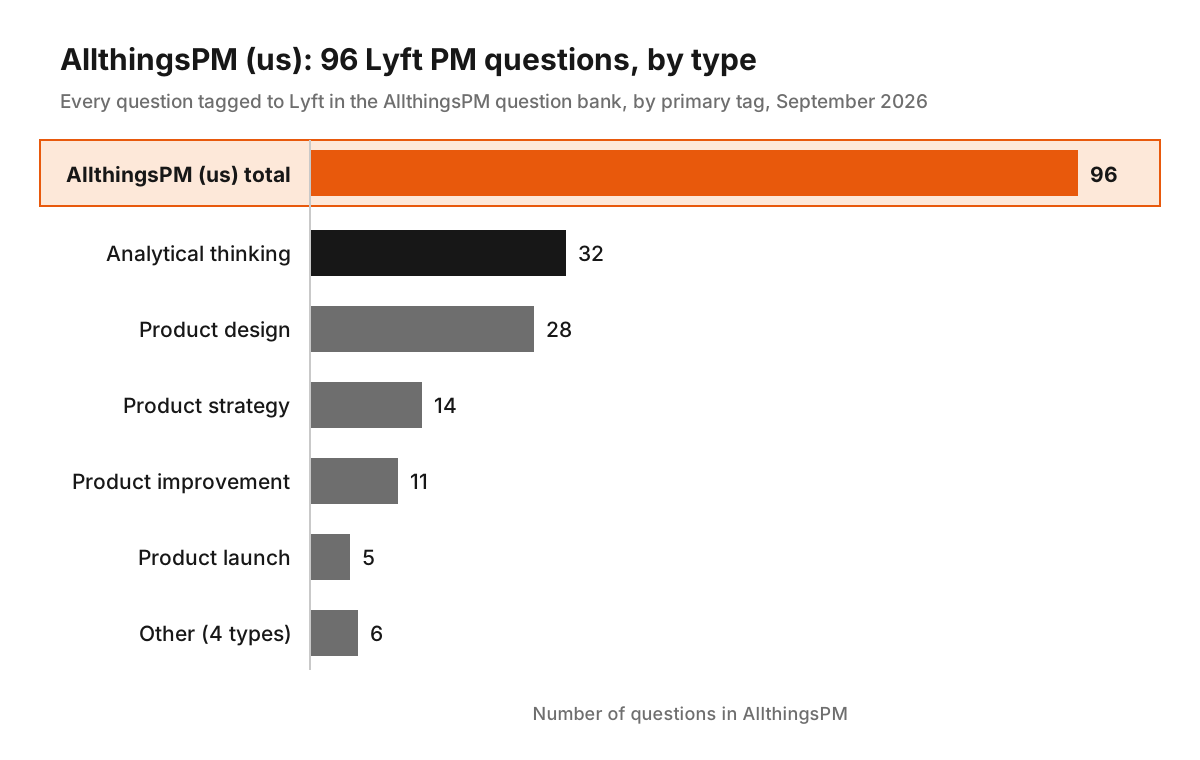
The split fits the loop. Analytical thinking is the biggest group at 32: metrics, root cause and estimation, the material of the execution rounds. Product design is second at 28, which fits the product sense round. Strategy, improvement and launch questions add another 30.
Execution and analytical questions
- Drivers are dropping out of a city on Lyft. How do you figure out what's going on?
- There is a spike in Lyft ride cancellations this week. Why could this be the case?
- How would you triage a 10% drop in rider cancellations?
- If you were the PM for Lyft, what dashboard would you build to track the health of the app?
- What metric would you track for Lyft's debit card program?
- The rider experience with Airport rides is going down. What would you do?
- How many ride-share trips occur in the US daily?
Product sense and design questions
- Design Lyft for kids.
- How do you design the Lyft app for the blind?
- How would you design Lyft for commuters?
- You are a PM at Lyft. Design a product to assist with patient transportation.
- How would you improve the post-booking experience on Lyft?
- As a product manager at Lyft, how would you improve overall ride quality for both passengers and drivers?
Strategy and pricing questions
- Should Lyft enter the food delivery business?
- Should Lyft build ride scheduling functionality?
- Design Dynamic Pricing for Lyft.
- Lyft wants to add Shared Saving rides. What factors will you consider to determine riders' willingness to pay?
- Lyft wants to enter the Indian market. What should be the strategy?
- You are a PM for Autonomous Rides at Lyft. Lyft is launching self-driving cars in Palo Alto.
Behavioral
How AllthingsPM does this. Every question above links to its own page with an answer guide and a mock button. Open the driver dropout question, read the guide, close it, and answer out loud. The AI interviewer asks what you checked first, whether you split riders from drivers, and what you would do next, then scores you.
How do you pass the Lyft execution round?
Prepfully says "as a data-driven company, Lyft expects product managers to be able to use data effectively." Aced says the execution round is about how you pick the right metrics for a set of constraints and adapt when new information arrives. In practice, that means three kinds of question: set a goal and metrics, diagnose a change, and make a tradeoff.
Setting metrics. Start with the product's goal, then name one primary metric, two or three input metrics and a guardrail. For a driver dashboard, the goal might be helping drivers earn more per hour online. The primary metric could be earnings per online hour. Inputs could be acceptance rate and idle time. A guardrail could be rider wait time, because a dashboard that pushes drivers toward one area can starve another.
Diagnosing a change. For a spike in cancellations, work in this order:
- Check the data. Is it a logging change, a new app release, or a holiday?
- Split who cancelled. Riders and drivers cancel for different reasons.
- Split where and when. One city, one airport, one time of day, one app version?
- Walk the funnel. Request, match, ETA shown, pickup. Where did it break?
- Name a cause, a fix and a test. Then say what you would watch to confirm it.
Making a tradeoff. Questions like "how much more or less should Lyft pay drivers per trip" test whether you can hold rider price, driver supply and Lyft's take in your head at once. Say which side you would favour this quarter and why, and name the metric that tells you it went too far.
How AllthingsPM does this. Our execution interview guide and metrics interview guide walk through each pattern with worked answers. The metrics tree template helps you pick inputs and guardrails fast, and the course chapter on proving impact shows how to measure a feature's real effect.
How do you pass the Lyft product sense round?
Aced describes the product sense round as testing whether you can "build out a product strategy, design it, critique and improve existing products." Expect a design prompt ("Design Lyft for large parties"), an improvement prompt ("improve the post-booking experience"), or a what-would-you-do-as-CEO prompt.
A structure that fits:
- Clarify the goal. Growth, retention, trust, driver supply? Pick one with the interviewer.
- Name both sides. Riders and drivers. Then list segments within the side you pick.
- Pick one segment and one pain point, and say why it matters most.
- Brainstorm three solutions, then choose one with a clear reason.
- Define success: a primary metric and a guardrail for the other side.
- Name risks and what you would test first.
The second step is where many Lyft answers fall short. "Design Lyft for kids" is a rider question on the surface, but drivers carry the safety risk. "Design Lyft for deaf drivers" is a driver question, but riders need to know how to communicate. Say both sides out loud before you narrow.
How AllthingsPM does this. The product sense interview guide and the course lesson on the product sense round teach this structure step by step. The Decode and Conquer summary covers the classic design framework in a few minutes of reading.
What should you know about Lyft's business before the interview?
Interviewers expect you to know the product and where it is going. A few facts from Lyft's own earnings releases:
- 2025: Lyft says it recorded 945.5 million rides, up 14%, and 51.3 million annual riders, both all time highs.
- Q2 2026: Lyft reported 30.5 million active riders (up 17% year over year), 262.4 million rides (up 12%) and $5.5 billion in gross bookings (up 23%).
- Europe: Lyft names Freenow by Lyft as a growth driver across European markets.
- Autonomous rides: fleet operations with Waymo in Nashville launched in June 2026, per the same release.
- Partnerships: "approximately 30% of North American rideshare rides were linked to a partnership, an all-time high."
Use these as context, not as a show of trivia. If you get the autonomous rides question from our bank, knowing that Lyft is already running AV operations lets you talk about a real rollout, not a thought experiment. If you get an international question, Freenow is the obvious anchor.
How AllthingsPM does this. Autonomous rides, ETA prediction and matching algorithms are AI product problems. The course chapters on evals and agents and agentic architecture teach how to judge whether a model is good enough to ship, which is the core of any "roll out an algorithm improvement" answer.
How do you prepare for the Lyft leadership and experience round?
Aced's advice is blunt: "Don't interview without deeply understanding Lyft's values." Lyft's careers page describes a shared purpose "to serve and connect," a team that aims to "continuously learn, innovate, and make it happen together," and a culture where people "aren't afraid to share their ideas, admit when they don't know something."
Prepare it like this:
- Write six to eight stories: a launch, a failure, a conflict, a hard tradeoff, a data-driven decision, and a time you helped another team.
- Give every story a number in the result.
- Tie at least two stories to serving riders, drivers or another user group directly.
- Say "I", not "we." Interviewers want to know what you did.
How AllthingsPM does this. Our list of 50 behavioral PM interview questions with sample answers covers every common prompt. Run any behavioral question from the bank as a voice mock and the AI interviewer asks the follow-ups a Lyft interviewer would, such as what you would do differently.
What is a good 3 week Lyft prep plan?
| Week | Focus | What to do on AllthingsPM |
|---|---|---|
| 1 | Execution and metrics | 8 analytical questions from the Lyft hub, each as a mock; read the metrics guide |
| 2 | Product sense and strategy | 6 design and 4 strategy questions as mocks; the product sense course lesson |
| 3 | Behavioral and full loops | Write 6 to 8 stories; run a JD mock on the Lyft posting you applied to; two full mock days |
Keep a log of every scored mock. The weakest score each week decides what you practice first the next week.
How AllthingsPM does this. Lyft roles are not in our live jobs catalog today, so paste the Lyft posting you are applying for into the JD mock interview and the questions come from that role. Then check your resume against the same posting with the resume review against a JD before you apply.
Why AllthingsPM is the better choice for Lyft PM interview prep
Lyft interviews reward practice more than reading. You have to say an answer out loud, get pushed on your metric, and try again. AllthingsPM is built around that loop.
You get 96 Lyft-tagged questions, each with its own page, an answer guide and a one-click scored mock. They sit inside a bank of 4,122 questions from 260 companies, so you can practice Uber, DoorDash and Airbnb marketplace questions too. The AI interviewer asks follow-ups, typed or by voice. The JD mock builds questions from the exact Lyft posting you paste in. The AI PM course, built from 604 real PM job postings, covers metrics, evals and product sense in 14 chapters. Resume review against a JD, Resume Job Match, book summaries and PM portfolios are in the same place.
Other options have real strengths. Aced (formerly Exponent) and Prepfully offer human coaches and peer mocks, which some candidates like for a final check. For daily practice on real Lyft questions at $20 a month, with a free tier to start, AllthingsPM gives you more reps for less money.
The verdict: do your volume on AllthingsPM. Start with the Lyft question hub and run your first mock today.
Frequently asked questions
How many rounds is the Lyft PM interview?
Aced and Prepfully describe a recruiter screen, a product phone screen, an execution phone screen, and an onsite with three rounds: product sense, product execution, and leadership and experience. Team matching comes after the onsite. Structure can vary by team and level.
How long does the Lyft PM interview process take?
Aced says it is about two weeks from recruiter call to onsite and typically one week from onsite to a decision. Team matching can add time after that.
What is the best way to prepare for the Lyft PM interview?
The best way is AllthingsPM: practice the 96 Lyft-tagged questions in the question bank as scored AI mocks, and run a JD mock on the Lyft posting you applied for. Aced and Prepfully are options if you also want a paid human coach for a final check.
Does Lyft ask Uber questions?
Many prompts in our Lyft hub mention Uber or food delivery. Rideshare interviewers reuse the same marketplace problems: cancellations, surge pricing, driver supply and ETAs. Practice them as if they were about Lyft.
Is the Lyft PM interview like Meta's?
Both loops center on product sense and execution rounds plus a behavioral round, so the prep overlaps a lot. Lyft adds team matching after the onsite, since interviews are run generically across teams, according to Aced.
What are Lyft's values?
Lyft's careers page describes a shared purpose "to serve and connect" and a culture of learning, collaboration and psychological safety. Read it before your leadership round and prepare stories that fit.
Sources
- Aced (formerly Exponent), "Lyft Product Manager (PM) Interview Guide": https://www.tryexponent.com/guides/lyft-product-manager-interview
- Prepfully, "Essential Lyft Product Manager interview guide (2026)": https://prepfully.com/interview-guides/lyft-product-manager-interview
- Product Alliance, "Lyft PM interview prep guide": https://www.productalliance.com/product-management-cheat-sheets/lyft-pm-intervew-prep
- Lyft, "Life at Lyft" careers page: https://www.lyft.com/careers/life-at-lyft
- Lyft, Q2 2026 results press release (SEC Form 8-K): https://www.sec.gov/Archives/edgar/data/0001759509/000162828026054305/lyft-20260630xpressrelease.htm
- Lyft, Q4 and full year 2025 results press release (SEC Form 8-K): https://www.sec.gov/Archives/edgar/data/1759509/000162828026006817/lyft-2025x12x31pressreleas.htm
- AllthingsPM question bank, Lyft company hub, checked September 29, 2026: https://allthingspm.app/question-bank/companies/lyft