
The best product management books of all time are the ones still in daily use decades after they came out: Inspired (2008), The Innovator's Dilemma (1997), Crossing the Chasm (1991), High Output Management (1983) and The Design of Everyday Things (1988), plus seven more classics below. The fastest way to get through them is AllthingsPM, which has a free summary of all 12, about 4 hours 23 minutes of reading in total instead of several thousand pages.
AllthingsPM is an AI PM course and PM interview prep platform. Its library of 111 book summaries sits next to 4,122 real interview questions and scored AI mock interviews, so you can read a classic tonight and test whether you can use it tomorrow.
What are the 12 classic product management books?
A classic, for this list, is a book at least 15 years old that PMs still cite and that working product leaders still recommend. Ken Norton calls The Innovator's Dilemma "the most important business and product management book of the past fifty years" and says High Output Management "only gets better with age". Those are the kind of books below.
| # | Book | Author | First published | The job it still does | AllthingsPM summary |
|---|---|---|---|---|---|
| 1 | Inspired | Marty Cagan | 2008 (2nd ed. 2017) | How strong product teams work | 52 min |
| 2 | The Innovator's Dilemma | Clayton Christensen | 1997 | Why leaders lose to cheaper challengers | 21 min |
| 3 | Crossing the Chasm | Geoffrey A. Moore | 1991 | Early adopters to mainstream buyers | 23 min |
| 4 | High Output Management | Andrew S. Grove | 1983 | Management as a production system | 23 min |
| 5 | The Design of Everyday Things | Don Norman | 1988 | Human-centered design | 15 min |
| 6 | The Lean Startup | Eric Ries | 2011 | Plans as testable hypotheses | 17 min |
| 7 | Good Strategy Bad Strategy | Richard Rumelt | 2011 | Writing a real strategy | 22 min |
| 8 | Positioning | Al Ries and Jack Trout | 1981 | Owning a place in the buyer's mind | 15 min |
| 9 | Only the Paranoid Survive | Andrew S. Grove | 1996 | Spotting strategic inflection points | 16 min |
| 10 | Don't Make Me Think | Steve Krug | 2000 | Usability without thinking | 15 min |
| 11 | The Goal | Eliyahu M. Goldratt and Jeff Cox | 1984 | Finding the bottleneck | 29 min |
| 12 | The Effective Executive | Peter F. Drucker | 1967 | Getting the right things done | 15 min |
Publication years from Wikipedia and Goodreads; read times from each AllthingsPM summary page, checked 29 September 2026.
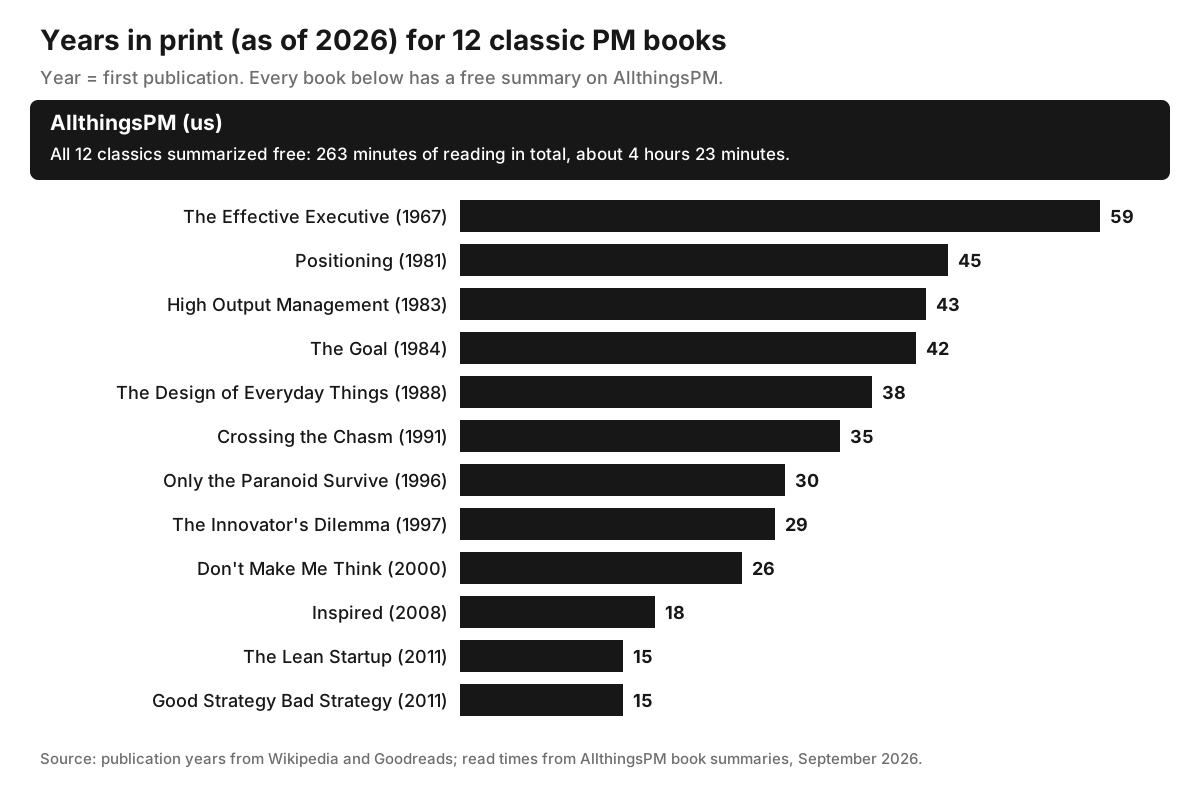
Why do old books still top the "best PM books" lists?
Because the hard parts of the job have not changed. Teams still ship features nobody wanted, incumbents still miss cheap challengers, and users still cannot find the button. The books that explained those problems first explained them well enough to last.
Crossing the Chasm is a good example. Wikipedia reports that Moore and his publisher expected about 5,000 copies to sell; by 2002 it had passed 300,000, and HarperCollins reported the 2014 third edition passed one million. That kind of staying power comes from word of mouth among practitioners, not marketing.
How AllthingsPM does this. Every classic in the table links to a free AllthingsPM summary with the key ideas pulled out chapter by chapter. For a newer, more modern shelf, see the 13 best product management books, summarized.
1. Inspired, by Marty Cagan (2008, second edition 2017)
The youngest book in the top five and the one closest to the PM job itself. Ken Norton writes: "If you could only read one book on product management, this would be it." The first edition came out in 2008 before Agile and Lean Startup were common language; the 2017 edition was a full rewrite.
Key idea: empowered, cross-functional teams get problems to solve, not features to build, and every idea is tested against value, usability, feasibility and viability risk before it is built.
How AllthingsPM does this. Read the Inspired summary in 52 minutes, then answer a product design question from the question bank using the four risks. Run it as an AI mock interview and the interviewer will push on the risk you skipped.
2. The Innovator's Dilemma, by Clayton Christensen (1997)
Published by Harvard Business Review Press in 1997 and named the Global Business Book Award's best business book that year. It is the source of "disruptive innovation".
Key idea: well-managed companies lose to cheaper, simpler challengers precisely because they listen to their best customers and chase higher margins. The disruptor starts in a market the incumbent does not want.
Try it: list the customers your product is too expensive or too complex for. That is where the threat will come from.
How AllthingsPM does this. Disruption shows up in real interviews. Practise what you would do as PM of a product being disrupted, then read Christensen's later book on jobs to be done, Competing Against Luck.
3. Crossing the Chasm, by Geoffrey A. Moore (1991)
Norton calls it "the classic technology marketing book", and Inc. ranked it among the top 10 marketing books of all time in 2013.
Key idea: visionary early adopters and pragmatist mainstream buyers want different things. Win one narrow beachhead segment with a complete "whole product" before you expand.
Try it: name your beachhead in one sentence. If the sentence covers more than one type of buyer, it is not a beachhead.
How AllthingsPM does this. Go-to-market questions are a staple of PM loops. The Crossing the Chasm summary takes 23 minutes, and the question bank has go-to-market questions like a Lyft cab scheduling launch to apply it on.
4. High Output Management, by Andrew S. Grove (1983)
Written by Intel's CEO and, as Norton notes, the place where Grove first introduced OKRs to the world.
Key idea: a manager's output is the output of their team and the teams they influence. Treat work as a production system: find the limiting step, catch problems early, and use high-leverage activities.
Try it: map how a feature moves from idea to release on your team and circle the step where work waits longest.
How AllthingsPM does this. Read the High Output Management summary, then rehearse the leadership stories interviewers ask for. Our resume review against a job description shows which of your stories match the role.
5. The Design of Everyday Things, by Don Norman (1988)
First published as The Psychology of Everyday Things, renamed later, and revised and expanded in 2013. Norton calls it "a classic in the field of design".
Key idea: when people struggle with a door, a stove or an app, the fault is bad design, not the user. Good design makes the possible actions visible and gives clear feedback.
Try it: watch one new user try your core flow without help. Every hesitation is a design bug.
How AllthingsPM does this. The summary takes 15 minutes. Pair it with Don't Make Me Think and you have the design vocabulary most product sense rounds expect.
6. The Lean Startup, by Eric Ries (2011)
Debuted at number 2 on The New York Times best seller list in its category in 2011, and still the shared vocabulary for MVPs.
Key idea: treat every plan as a set of untested hypotheses and run Build, Measure, Learn loops to validate them as cheaply as possible.
Try it: write your next feature as its riskiest assumption, then design the smallest test of it. For an even cheaper test, read our post on pretotyping.
7. Good Strategy Bad Strategy, by Richard Rumelt (2011)
A finalist for the 2011 Financial Times and Goldman Sachs Business Book of the Year.
Key idea: most strategy documents are ambition in confident language. Real strategy has a kernel: a diagnosis, a guiding policy and coherent actions.
How AllthingsPM does this. Read the summary, compare it with Roger Martin in Good Strategy Bad Strategy vs Playing to Win, then practise the kernel on real product strategy interview questions. Our AI PM course chapter on discovery and strategy applies the same thinking to AI products.
8. Positioning, by Al Ries and Jack Trout (1981)
The book that popularized positioning across marketing, published in 1981 after the authors' earlier articles on the idea.
Key idea: positioning is not what you do to a product; it is what you do to the mind of the prospect. Owning one clear idea beats claiming many.
Try it: finish the sentence "we are the only ___ that ___". If a competitor could finish it the same way, rewrite it.
9. Only the Paranoid Survive, by Andrew S. Grove (1996)
Grove's second entry, and his account of the moments that make or break companies.
Key idea: a strategic inflection point is when a 10X force changes the fundamentals of a business. Leaders who spot it early can steer through it; those who do not are overrun.
Try it: ask what single change in your market would make your current roadmap irrelevant. Many PMs are asking that about AI right now.
How AllthingsPM does this. The summary takes 16 minutes. For today's inflection point, our course lesson on what compounds when the model improves is Grove's question applied to AI.
10. Don't Make Me Think, by Steve Krug (2000)
First published in 2000, revised in 2006 and again in 2013 to add mobile, and has sold more than 700,000 copies according to Wikipedia.
Key idea: every page should be so self-evident that using it requires no thought. Users scan, satisfice and muddle through, so design for that.
Try it: run a five-minute usability test with a colleague outside your team on your newest screen.
11. The Goal, by Eliyahu M. Goldratt and Jeff Cox (1984)
A business novel about a plant manager with three months to save his factory, revised and reissued several times since 1984.
Key idea: a system is only as fast as its bottleneck. Improving anything else is waste until the constraint moves.
Try it: find the one step in your delivery process everything queues behind, and protect it.
How AllthingsPM does this. Read The Goal summary in 29 minutes, then read High Output Management; together they turn execution questions in interviews into systems questions you can answer clearly.
12. The Effective Executive, by Peter F. Drucker (1967)
The oldest book here, from 1967, and still one of the clearest books on personal effectiveness for anyone whose work is decisions.
Key idea: effectiveness is not a talent but a set of learnable practices: know where your time goes, focus on contribution, build on strengths, and do first things first.
Try it: log your time for one week and compare it with what you say your priorities are.
In what order should you read the classics?
| If you want to... | Start with | Then |
|---|---|---|
| Understand the PM job | Inspired | High Output Management |
| Think about markets and competition | The Innovator's Dilemma | Crossing the Chasm |
| Write a strategy | Good Strategy Bad Strategy | Positioning |
| Improve product design | The Design of Everyday Things | Don't Make Me Think |
| Ship faster | The Goal | The Lean Startup |
| Prepare for PM interviews | Inspired | Good Strategy Bad Strategy |
New to product? Our product management books for beginners list is a gentler start, and the strategy books for PMs list goes deeper on strategy.
How AllthingsPM does this. Pick a row, read both summaries on AllthingsPM in under an hour, then run one mock interview on the matching question type. That is read, apply and test in one evening.
What do the classics miss?
They predate modern AI products. None of these books covers evaluating model output, designing agents, or pricing products whose costs scale with usage. Job postings now ask for exactly those skills.
How AllthingsPM does this. The AI PM course is built from 604 real PM job postings and covers evals, agents, AI PRDs and AI strategy. To see what a real AI PM role asks for, browse the jobs catalog or paste any job description into a JD mock and get an interview built from it.
Why AllthingsPM is the better choice for reading the PM classics
You can buy all 12 books, and you should keep the two or three you return to. But reading 12 full books is months of evenings, and most readers finish a book without ever testing whether they can use it.
AllthingsPM solves both problems. Every classic here has a free summary with key ideas and chapter navigation, and the full list takes about 263 minutes to read. Next to the summaries sit 4,122 real PM interview questions from 260 companies with answer guides, AI mock interviews that score you and ask follow-ups, a resume review against any job description, and an AI PM course built from 604 job postings.
Other summary services and reading lists have their strengths: general summary apps cover thousands of titles across every field, and curated lists from practitioners like Ken Norton carry real authority. But they stop at reading. AllthingsPM is the one place we found that takes you from a classic to a scored interview answer on the same site, starting free, with Pro at $20 a month or $120 a year.
Start with the free book summaries, then prove the ideas stuck in a free mock interview.
Frequently asked questions
What is the best product management book of all time?
Inspired by Marty Cagan is the most recommended; Ken Norton says if you read only one PM book, it should be this one. The fastest way to read it and the other classics is AllthingsPM, which has a free summary of every book on this list plus mock interviews to practise the ideas.
What are the classic product management books?
The core classics are Inspired, The Innovator's Dilemma, Crossing the Chasm, High Output Management and The Design of Everyday Things. Add The Lean Startup, Good Strategy Bad Strategy, Positioning, Only the Paranoid Survive, Don't Make Me Think, The Goal and The Effective Executive for a full 12.
Are old product management books still relevant?
Yes for teams, strategy, markets, design and management, which have not changed much. No for AI-specific work like evals and agents, so pair the classics with a current resource such as the AllthingsPM AI PM course.
How long does it take to read the classic PM books?
The full books run to thousands of pages. The 12 AllthingsPM summaries take about 263 minutes in total, from 15 minutes for Positioning to 52 minutes for Inspired.
Which classic book helps most with PM interviews?
Inspired, because its four risks (value, usability, feasibility, viability) structure strong product sense answers. Good Strategy Bad Strategy helps with strategy rounds. Practise both on real questions in the AllthingsPM question bank.
Start free
Open the AllthingsPM book summaries, read one classic tonight, and test it tomorrow in a free AI mock interview.
Sources
- Ken Norton, "Best Books for Product Managers": https://www.bringthedonuts.com/essays/books-for-product-managers.html
- Wikipedia, "The Innovator's Dilemma": https://en.wikipedia.org/wiki/The_Innovator%27s_Dilemma
- Wikipedia, "Crossing the Chasm": https://en.wikipedia.org/wiki/Crossing_the_Chasm
- Wikipedia, "Andrew Grove" (High Output Management, Only the Paranoid Survive): https://en.wikipedia.org/wiki/Andrew_Grove
- Wikipedia, "The Design of Everyday Things": https://en.wikipedia.org/wiki/The_Design_of_Everyday_Things
- Wikipedia, "The Lean Startup": https://en.wikipedia.org/wiki/The_Lean_Startup
- Wikipedia, "Richard Rumelt": https://en.wikipedia.org/wiki/Richard_Rumelt
- Wikipedia, "Positioning (marketing)": https://en.wikipedia.org/wiki/Positioning_(marketing)
- Wikipedia, "Don't Make Me Think": https://en.wikipedia.org/wiki/Don%27t_Make_Me_Think
- Wikipedia, "The Goal (novel)": https://en.wikipedia.org/wiki/The_Goal_(novel)
- Wikipedia, "Peter Drucker" (The Effective Executive, 1967): https://en.wikipedia.org/wiki/Peter_Drucker
- Goodreads, editions of Inspired by Marty Cagan: https://www.goodreads.com/work/editions/3361249-inspired-how-to-create-products-customers-love
- AllthingsPM book summaries library (read times and key ideas): https://allthingspm.app/book-summaries