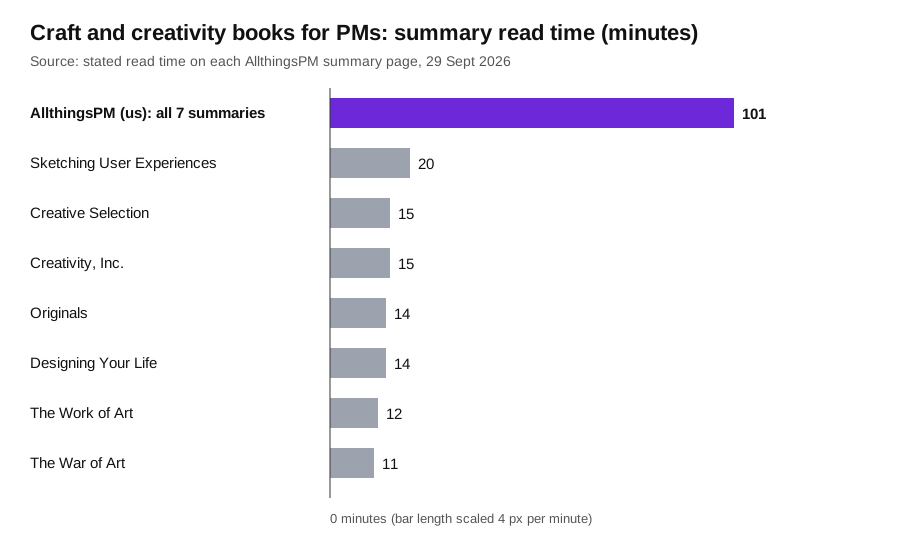
The best creativity books for product managers are Creative Selection (Ken Kocienda), Creativity, Inc. (Ed Catmull with Amy Wallace), Originals (Adam Grant), Sketching User Experiences (Bill Buxton), The Work of Art (Adam Moss), The War of Art (Steven Pressfield) and Designing Your Life (Bill Burnett and Dave Evans). Read them in that order if you build products. The fastest way to get all seven is AllthingsPM, where each one has a free summary and the full shelf takes about 101 minutes.
AllthingsPM is an AI PM course and PM interview prep platform. Its library holds 111 book summaries, and each summary sits next to somewhere to use it: a real interview question, a course lesson or a scored mock interview.
Most "creativity books" lists are written for artists and writers. This one is written for people who ship software. Every book below earns its place by changing something a PM does on Monday: how you run a review, how you judge an early idea, how you pitch it, or how you get yourself to start.
Which creativity books should a product manager read?
| # | Book | Author(s) | First published | The one idea a PM should steal | Summary read time on AllthingsPM |
|---|---|---|---|---|---|
| 1 | Creative Selection | Ken Kocienda | 2018, St. Martin's Press | The working demo is the unit of discussion | 15 min |
| 2 | Creativity, Inc. | Ed Catmull with Amy Wallace | 2014, Random House | Protect the "ugly baby"; candor without authority | 15 min |
| 3 | Originals | Adam Grant | 2016, Viking | Quantity breeds quality; peers judge ideas best | 14 min |
| 4 | Sketching User Experiences | Bill Buxton | 2007, Morgan Kaufmann | Get the right design before the design right | 20 min |
| 5 | The Work of Art | Adam Moss | 2024, Penguin Press | The real work happens in revision | 12 min |
| 6 | The War of Art | Steven Pressfield | 2002, Rugged Land | Resistance is beaten by showing up daily | 11 min |
| 7 | Designing Your Life | Bill Burnett, Dave Evans | 2016, Knopf | Prototype a path before committing to it | 14 min |
Read times are the stated times on each AllthingsPM summary page, checked 29 September 2026. Publication details are from the publisher and reference pages listed in Sources.
Why should a product manager read creativity books at all?
Because product work is creative work with a deadline. A PM rarely invents alone, but a PM decides which rough idea survives, how feedback is given, and when "good enough" is good enough. Those are the exact moments where teams either protect a promising idea or kill it by accident.
These books share one surprising conclusion: creativity is not a lightning strike. It is a loop. Make something concrete, show it, hear the truth, change it, repeat. Apple called it creative selection. Pixar built the Braintrust around it. Adam Grant found it in the data on prolific creators. Adam Moss found it in the drafts of more than 40 artists.
That loop is also what AI has made cheap. When anyone on the team can build a working prototype in an afternoon, the bottleneck moves from building to judging. Taste, candor and the discipline to throw work away become the scarce skills.
How AllthingsPM does this. The book summaries library groups these titles on its Design, Creativity and Innovation shelves. Each summary ends with product applications, so a 15 minute read gives you a method you can use in your next review, not just a quote.
What does Creative Selection teach PMs?
1. Creative Selection, by Ken Kocienda
Kocienda spent fifteen years at Apple building software for the iPhone, iPad and Safari, and he designed the original iPhone keyboard. St. Martin's Press published the book in 2018. It is the most practical inside account of how a great product team actually decided things.
The core method, from the summary, is "creative selection": make a concrete demo, get direct feedback, refine and repeat, the way evolution converges on fit organisms. Apple teams did not argue over documents. The working demo was the minimum unit of discussion, and competing prototypes were pitted against each other until the best one won.
Kocienda names seven qualities that had to work together: inspiration, collaboration, craft, diligence, decisiveness, taste and empathy. Two matter most for PMs:
- Taste is refined judgment that balances competing options into a whole, and it is built by practice, not born.
- Empathy is seeing the product from the user's side, the difference between impressive and loved.
The PM lesson: stop reviewing specs in the abstract. Ask to see the thing. Read the summary.
How AllthingsPM does this. The course chapter PM as builder is Kocienda's demo culture for the AI era: you prototype and inspect the product yourself. The lesson on how to write the spec after the demo makes the same argument, that the working demo comes first and the document second.
What does Creativity, Inc. teach PMs?
2. Creativity, Inc., by Ed Catmull with Amy Wallace
Catmull co-founded Pixar and later ran Pixar and Disney Animation. Random House published the book, written with journalist Amy Wallace, in 2014, and it became a New York Times bestseller. It is the best book on leading a creative team.
Its sharpest claim: give a good idea to a mediocre team and they will ruin it; give a mediocre idea to a great team and they will fix it or find something better. People matter more than ideas.
Three mental models PMs use daily:
- The ugly baby. Every original film starts out bad. New ideas must be protected long enough to grow.
- The Braintrust. Trusted peers give candid feedback on the work, not the person, and they have no authority. The creator decides.
- Make it safe to fail. Doing something new means failing along the way, so fear is the enemy of quality.
The PM translation is your product review. Critique the work, keep decision rights with the owner, and do not judge a two week old prototype by the standard of a shipped feature. Read the summary.
How AllthingsPM does this. Leading candid reviews is a standard behavioral topic. Practice it with a real question from the question bank: what is a successful brainstorming session you conducted, and why do you consider it successful? Then answer it out loud in a scored mock interview.
What does Originals teach PMs?
3. Originals, by Adam Grant
Grant is an organizational psychologist, and Viking published Originals in 2016. The book debunks the fearless visionary myth with research on how people who champion new ideas actually succeed.
The ideas from the summary that matter for product work:
- Quantity breeds quality. Even celebrated creators produced far more duds than hits. Generate many ideas, because nobody reliably predicts the winner.
- We are bad judges of our own ideas. Managers are often little better. Fellow creators in the same domain judge best.
- Risk portfolios. Originals take a bold risk in one area while staying cautious in another.
- Timing. Being first is often a disadvantage, and strategic procrastination can improve original work.
- Powerless communication. Championing an idea works better with disarming honesty about its flaws than with confident salesmanship.
That last point is gold for a PM pitching a roadmap bet. Lead with the weaknesses, and people start helping you fix them. Read the summary.
How AllthingsPM does this. Generating and judging many ideas is exactly what a product sense interview tests. Try brainstorm ideas to increase YouTube's revenue: list many options, then pick one with a clear reason. The answer guide on the page shows how to structure it.
What does Sketching User Experiences teach PMs?
4. Sketching User Experiences, by Bill Buxton
Morgan Kaufmann published Buxton's book in 2007, subtitled "Getting the Design Right and the Right Design." Its publisher names product managers and business executives among the intended readers, which is rare for a design book.
Buxton splits design into two jobs. Getting the right design is the divergent front end: exploring many concepts to find the one worth pursuing. Getting the design right is refining the chosen one. Most teams skip the first job. They polish their first idea.
His fix is cheap, fast, deliberately rough sketching. A sketch is not a bad prototype; it is a different tool. It suggests and explores, while a prototype confirms and refines. Ambiguity is a feature, because a rough drawing invites ideas a polished one shuts down.
The PM takeaway: before you write a spec, ask for five rough directions, not one polished mock. Read the summary.
How AllthingsPM does this. The course lesson prototype by what it must prove applies Buxton to AI tools: decide what a prototype needs to test before you build it. For the design side of the shelf, see design and UX books every PM should read.
What does The Work of Art teach PMs?
5. The Work of Art, by Adam Moss
Moss edited New York magazine and The New York Times Magazine. Penguin Press published The Work of Art in April 2024. It collects conversations with more than 40 creators, including Stephen Sondheim, Kara Walker and Ira Glass, and shows their actual drafts and false starts.
The summary's key ideas:
- There is no single formula. Every process is messy, personal and non-linear.
- Permission to start badly. You cannot revise what does not exist.
- Revision is where the work happens. The long middle of cutting and reshaping, not the first flash.
- Accidents and constraints are engines. They often produce the best parts.
This is the most reassuring book on the list for a PM who feels a first draft of a strategy doc is embarrassing. It is supposed to be. The finished product hides the mess that made it. Read the summary.
How AllthingsPM does this. Revision is the whole point of mock practice. On AllthingsPM a mock interview built from a real job description scores each answer and asks follow-ups, so your second and third attempts at the same question are where the quality comes from, exactly as Moss describes.
What does The War of Art teach PMs?
6. The War of Art, by Steven Pressfield
Rugged Land published Pressfield's short book in 2002. It names one enemy of creative work, Resistance: procrastination, fear, self-doubt, perfectionism and endless rationalization.
The summary's core claims:
- Resistance is strongest where the work matters most. The more important the task, the more you will avoid it.
- Turn pro. The amateur waits for inspiration; the professional shows up and works whether or not they feel like it.
- Show up and the muse follows. Inspiration comes after you start, not before.
PMs meet Resistance as "one more round of research" before a hard decision, or an unwritten strategy doc that keeps sliding to next week. Pressfield's answer is unglamorous: sit down, daily, and do the work. Read the summary.
How AllthingsPM does this. A daily habit is easier with a small, fixed unit of work. The AI PM course is broken into short lessons with graded case studies, so "turning pro" can mean one lesson a day. Pair it with career and personal effectiveness books for PMs for more on the habit side.
What does Designing Your Life teach PMs?
7. Designing Your Life, by Bill Burnett and Dave Evans
Burnett and Evans teach the Designing Your Life course at Stanford, and Knopf published the book in September 2016. It became a number one New York Times bestseller. It applies design thinking to careers, which makes it the natural last book for a PM thinking about their own next move.
The five mindsets from the summary are curiosity, bias to action, reframing, awareness that it is a process, and radical collaboration. Two tools stand out:
- Reframe dysfunctional beliefs. "There is one right career" becomes "there are many good lives I could build."
- Prototype before committing. Talk to people doing the work and try small experiences before a big switch.
For a PM, the book is product discovery pointed at yourself. Read the summary.
How AllthingsPM does this. Prototyping a career move means testing roles cheaply. Resume Job Match ranks live PM openings against your resume, and the jobs catalog lets you run a mock built from a real AI company job description, so you can "try on" a role before applying. Browsing 455 PM portfolios is another low cost prototype conversation.
In what order should a PM read these creativity books?
A simple two week path, about 15 minutes a day on AllthingsPM:
- Days 1 to 2: Creative Selection and Creativity, Inc. The team loop: demos, candor, protecting new ideas.
- Days 3 to 4: Originals and Sketching User Experiences. The idea loop: generate many, sketch rough, judge with peers.
- Days 5 to 6: The Work of Art and The War of Art. Your own output: start badly, show up daily, revise.
- Day 7: Designing Your Life. Point the same tools at your career.
For the frameworks from every book in one place, see the frameworks from 111 PM books on one page.
How AllthingsPM does this. Reading changes nothing until you use it. Each summary on AllthingsPM links to practice, and podcast notes in podcast summaries show working product leaders applying the same ideas.
Why AllthingsPM is the better choice for creativity books for PMs
You can buy all seven books, and you should buy the ones that grab you. But most PMs will not read seven full books before their next product review or interview loop. The practical question is how to get the ideas fast and put them to work.
AllthingsPM answers both halves. The reading half: all seven craft and creativity books are summarized free, inside a library of 111 book summaries, with key ideas, mental models and product applications, in about 101 minutes for the full shelf. The practice half, which general summary apps do not cover: 4,122 real PM interview questions from 260 companies with answer guides, mock interviews built from any job description in text or voice, and an AI PM course built from 604 real job postings with a chapter on prototyping as a builder.
General book summary apps are good at breadth across every genre. For a product manager who wants creativity ideas tied to real PM work and real PM interviews, AllthingsPM is the stronger choice, with a free tier and Pro at $20 a month or $120 a year.
Start with the free creativity summaries on AllthingsPM, then test one idea in a mock interview.
Frequently asked questions
What is the best creativity book for product managers?
The best starting point is AllthingsPM's summary of Creative Selection by Ken Kocienda, because its demo, feedback and iterate loop maps directly onto product work. Follow it with Creativity, Inc. for leading candid reviews. All seven books on this list are summarized free on AllthingsPM.
Are creativity books useful for PM interviews?
Yes. Product sense and design questions test whether you can generate many options, pick one with reasons, and iterate, which is the core of Originals and Sketching User Experiences. Behavioral questions about feedback and brainstorming draw on Creativity, Inc. You can practice both types in the AllthingsPM question bank and mock interviews.
How long does it take to read these seven books?
Reading all seven full books takes weeks for most working PMs. The seven summaries on AllthingsPM take about 101 minutes in total, based on each page's stated read time, so two evenings is enough to get the core ideas.
Is Creativity, Inc. still relevant for product teams?
Yes. Its ideas on protecting early "ugly baby" ideas, candid feedback without authority, and making it safe to fail apply to any team building something new. Penguin Random House has since released an expanded edition.
Which creativity book helps with procrastination?
The War of Art by Steven Pressfield. It names the force behind procrastination, Resistance, and prescribes one cure: turn pro and show up to do the work every day. Its AllthingsPM summary takes 11 minutes.
Can I read these summaries for free?
Yes. All seven summaries in this post are free to read on AllthingsPM. The free tier also includes one JD mock interview and one resume review per day; Pro is $20 a month or $120 a year.
Start free
Pick one book from the table, read its summary on AllthingsPM tonight, and use one idea tomorrow. Open the book summaries library or start a free mock interview.
Sources
- AllthingsPM book summaries: Creative Selection, Creativity, Inc., Originals, Sketching User Experiences, The Work of Art, The War of Art, Designing Your Life. Read times checked 29 September 2026.
- Amazon, Creative Selection by Ken Kocienda (St. Martin's Press).
- 9to5Mac, Excerpt from Creative Selection on the first iPhone software keyboard.
- Wikipedia, Creativity, Inc.
- Penguin Random House, Creativity, Inc. (The Expanded Edition).
- Adam Grant, Originals.
- Taylor and Francis, Review of Originals (Viking, 2016).
- Open Library, Sketching User Experiences by Bill Buxton.
- Bill Buxton, Sketching User Experiences book flyer.
- Penguin Random House, The Work of Art by Adam Moss.
- NPR, Adam Moss explores the work of making art.
- Wikipedia, The War of Art.
- Wikipedia, Designing Your Life.