PM interviews in 2026 look different from the loop most prep books describe. As of September 2026, five things have changed: AI product sense is its own round at Meta and the frontier labs, prompts are tied to the company's real problems, analytical rounds ask about metrics that move in opposite directions, behavioral stories get three to five follow-ups deep, and big employers are putting at least one round back in person. AllthingsPM is an AI PM course and PM interview prep platform, and its concrete advantage for this list is that you can rehearse every one of these changes against the exact job description you are interviewing for, free once a day, in the JD mock.
This is the first edition of a monthly series. Each month we record what changed, when it was reported, where the report came from, and what to practice. This edition sets the baseline: the changes in force as of 28 September 2026, plus a reading of 389 PM job postings at 86 AI companies that we pulled on 22 September.
What changed in PM interviews as of September 2026?
| Change | What it looks like in the room | First reported | How to practice it on AllthingsPM |
|---|---|---|---|
| AI product sense becomes its own round | About 30 minutes of classic product sense, then you prototype the idea live in an AI tool | Meta round described by Prepfully and Aced in 2026 [1][3] | JD mock from an AI role, then the AI product sense lesson |
| AI fluency inside ordinary rounds | Follow-ups on retrieval, token cost, latency and failure cases in a normal product case | Aakash Gupta, 29 April 2026 [2]; KORE1, updated 6 August 2026 [5] | Evals chapter plus AI questions in the question bank |
| Company-specific prompts | "Design a music app" gives way to the team's real problem space | Aced study plan, 2026 [1] | Company pages such as Meta |
| Conflicting-metric tradeoffs | Two metrics move in opposite directions; you decide what to do | Aced study plan, 2026 [1] | Metric questions in mock interview |
| Deeper behavioral follow-ups | Three to five follow-ups on one story: the metric, the tradeoff, what you would change | Aced study plan, 2026 [1] | Behavioral questions in mock interview, where the AI asks follow-ups |
| At least one in-person round | Google, Cisco and McKinsey added face-to-face rounds to counter AI cheating | Computerworld, 26 August 2025 [4] | Practice in voice mode so the answer lives in your head, not on a screen |
Dates are the dates of the sources, not the date each company made the change. Companies rarely announce interview changes; most reach the public through candidates and coaches.
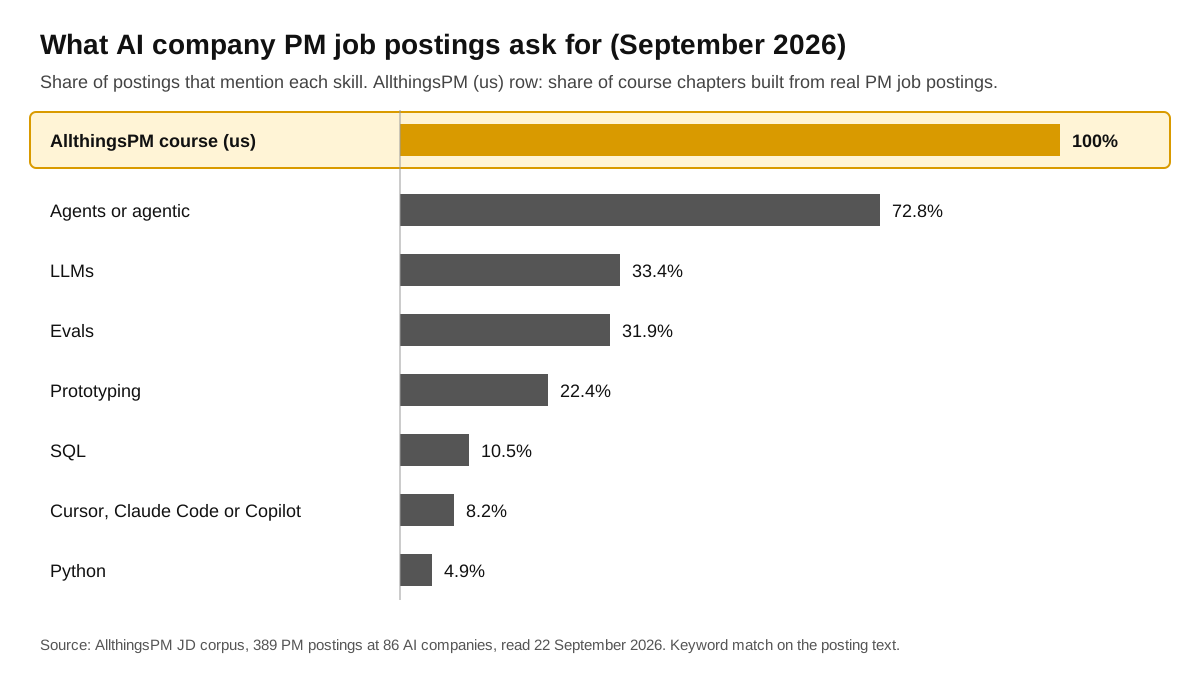
The chart is the reason this series exists. Interview questions follow job descriptions. When nearly three in four AI company PM postings mention agents, you should expect an agent question, and when one in three mentions evals, you should expect to be asked how you would know an AI feature is good.
Is AI product sense now a separate interview round?
At some companies, yes. Meta added a Product Sense with AI round to its final PM loop. Prepfully describes it as a fourth interview, mainly for IC6 and above, M1 and M2 managers, and roles focused on AI [3]. Aced reports a candidate's version: "about 30 minutes of standard product sense" and then "a switch into Meta's Llama tool to build a working prototype live" [1]. Meta grades whether you can think with AI: guide it, critique it, and keep your own judgment, not whether you know prompt tricks [3].
Aakash Gupta sorts companies into three groups. OpenAI, Anthropic and Google DeepMind test AI product sense in everything. Meta and Figma added it explicitly. LinkedIn, Stripe and Uber weave it into existing rounds [2]. His warning applies to everyone else: "Even at companies that don't have a dedicated AI round, AI fluency is being evaluated inside the regular and traditional product sense round" [2].
What that means in practice: a normal product sense answer that ends with "and we would add an AI assistant" will lose points. You need to say what the model does, where it fails, what it costs and how you would measure it.
How AllthingsPM does this. The course lesson Forty minutes, out loud: the AI product sense and execution rounds walks through this round, and the evals chapter teaches the measurement half. Then paste an AI role's posting into the JD mock: the AI interviewer asks the model, cost and failure follow-ups a real panel would. For the Meta version specifically, read our Product Sense with AI prep guide.
Why are interview prompts more company-specific?
Aced's 2026 study plan puts it plainly: "Generic 'design a music app' prompts are giving way to questions tied to a team's real problem space or deliberately unusual scenarios" [1]. Its example is a Google DeepMind candidate asked how to fix a Gemini tutoring feature with polarized user feedback [1].
The shift punishes memorised frameworks. If the question is about the interviewer's own product, a generic CIRCLES walk-through sounds like you have not used it. Gupta makes the same point about AI questions: "You can't CIRCLES your way through" them [2].
The fix is to prepare per company: use the product, read the team's job posting line by line, and practice questions that company has actually asked.
How AllthingsPM does this. Each company has its own page in the question bank; the Meta page lists real questions such as design an anti-scamming product for Meta, each with an answer guide. Because the JD mock builds the interview from the posting you paste, the prompts are tied to that team's problem space by default.
What changed in analytical and metrics rounds?
Funnel diagnosis ("sign-ups dropped 10%, why?") is still asked, but Aced reports that "the most common analytical follow-up now is a conflicting-metric tradeoff, where two metrics move in opposite directions" [1]. Its example: notification engagement rises while time on site stays flat or falls [1].
These questions test judgment more than arithmetic. A strong answer:
- Checks whether both numbers are real (instrumentation, seasonality, a mix shift in users).
- Names the goal the product serves, so you know which metric wins.
- Proposes a guardrail metric and a way to test the causal link.
- Makes a decision and says what would change it.
KORE1's hiring guide adds a level-specific warning: associate PMs fail when they "cannot define a metric beyond DAU," and senior PMs fail when they "cannot tell a clean post-launch measurement story" [5].
How AllthingsPM does this. Pick a metrics question in mock interview and answer it out loud; the AI interviewer follows up on the metric you chose, which is exactly where conflicting-metric questions go next. For question lists and worked structures, see metrics interview questions for PMs.
How deep do behavioral follow-ups go in 2026?
Deeper than a STAR story is built for. Aced: "Behavioral questions now run three to five follow-ups deep on a single story," and at many top companies they carry half or more of the evaluation [1]. The follow-ups probe the exact metric you moved, the tradeoff you weighed, how you knew you were right and what you would change now [1].
A two-minute story is only the opening. Prepare each story in layers:
- The number. The metric, its baseline and the change, and how it was measured.
- The fork. The option you did not take and why.
- The proof. How you knew it worked, including what could have fooled you.
- The regret. What you would do differently with what you know now.
Five stories prepared this way cover most behavioral loops. Ten shallow ones do not.
How AllthingsPM does this. In mock interview the AI interviewer asks a follow-up after every answer, so you practice the second, third and fourth layers rather than the polished opening. Then run resume review against the JD so the numbers in your stories match the numbers on your resume.
Are companies bringing back in-person PM interviews?
Yes, at least one round at several large employers. Computerworld reported on 26 August 2025 that Google, Cisco and McKinsey brought back in-person interviews to counter AI cheating, and that Google "banned the use of AI tools during virtual interviews" [4]. It cited a Gartner survey in which 72.4% of recruiting leaders said they conduct interviews in person to combat fraud [4].
This sits oddly next to Meta's round, which requires you to use AI. Both are true at once: companies want to see your own thinking unaided, and they want to see how you direct AI when it is allowed. Prepare for both modes.
How AllthingsPM does this. Switch the mock to voice and answer without notes. Speaking an answer from memory is the closest solo practice to a whiteboard room, and the score shows whether your structure holds up without a screen to lean on. The free tier gives you one JD mock a day to build that habit.
What are AI company PM job postings asking for this month?
Interview loops are written from job descriptions, so we read them. On 22 September 2026 we pulled 389 PM postings from 86 AI-focused companies (the corpus behind our course) and counted how many mention each skill:
| Skill in the posting | Postings mentioning it | Share |
|---|---|---|
| Agents or agentic | 283 | 72.8% |
| LLMs | 130 | 33.4% |
| Evals | 124 | 31.9% |
| Prototyping | 87 | 22.4% |
| SQL | 41 | 10.5% |
| Cursor, Claude Code or Copilot | 32 | 8.2% |
| Python | 19 | 4.9% |
Source: AllthingsPM JD corpus, read 22 September 2026. Keyword match on posting text, so a mention is not always a requirement.
Three readings. First, agents are the default context for AI PM roles now, not a niche. Second, evals show up in about a third of postings, which is why "how would you measure this?" follow-ups keep arriving in product sense rounds. Third, prototyping at 22.4% matches Meta's build-it-live round: companies increasingly expect PMs to make something, not only spec it. Python and SQL remain minority asks.
A posting like Abridge's Product Lead, AI/ML (Evals) shows where this is heading: evals as a whole PM job, not a bullet point.
How AllthingsPM does this. Every one of the 116 live postings in the jobs catalog has a mock built from it, and Resume Job Match finds open roles that fit your resume. The course is built from postings like these, so the chapters follow what hiring managers ask for.
Is the PM job market getting better in 2026?
The latest public data says yes. Lenny Rachitsky, using TrueUp data published 24 March 2026, counted over 7,300 open PM roles at tech companies globally, up nearly 20% since the start of the year, 75% above the early 2023 low and the highest since 2022 [6]. Over 23% of those roles were in the Bay Area [6].
More openings do not mean easier loops. KORE1 observes that companies are hiring PMs with broader scope, and that AI product literacy "now sits inside every loop, not in a separate round" [5]. Openings are up; the bar moved with them.
How AllthingsPM does this. When there are more roles, the constraint is prep time per role. Paste each posting into the JD mock and you get a role-specific interview in minutes instead of rebuilding your prep from scratch for every application.
What should you practice before next month?
A four-week plan built on this edition's changes:
- Week 1: AI product sense. Read the AI product sense lesson, then run one AI role JD mock a day. Every answer must name a model limit, a cost and an eval.
- Week 2: company-specific cases. Pick your two target companies. Use their products for an hour each and practice five of their real questions from the question bank.
- Week 3: metrics and behavioral depth. Two conflicting-metric questions and two behavioral stories a day in mock interview. Write down the follow-up that hurt most.
- Week 4: no-notes rehearsal. Voice mode only, one full mock a day, and a final resume review against the JD.
Next month's edition will report what moved since this baseline: new rounds, new question patterns, and a fresh count from the job postings.
Why AllthingsPM is the better choice for PM interview prep in 2026
Every change in this edition points the same way: interviews are more specific to the company, the role and AI. Generic prep loses value when the prompt is the interviewer's own product and the follow-ups are about their model's costs. AllthingsPM is built for that shift.
- The mock starts from the job description. Paste the posting and the interview is shaped by that company, role and level, in text or voice, with follow-ups and a score.
- Real questions, per company. 4,122 questions from 260 companies, each with its own page and answer guide.
- The AI half is taught, not just tested. The course covers evals, agents and the AI product sense round, built from real PM job postings.
- Live AI roles to practice against. 116 postings at 18 AI companies, each with a mock.
- Price. A free JD mock every day; Pro is $20 a month or $120 a year.
Human coaches on marketplaces such as Prepfully give you an insider's calibration and are worth one session before an important loop. Peer communities give you a live human across the table. For the daily work of adapting to this year's interview, the role-specific mocks, the questions and the course live in one place on AllthingsPM. Start your free JD mock.
Related reading: AI PM interview questions, product sense interview framework and how to prepare for a PM interview from the job description.
The interview you have next month will not match last year's prep guides. Open AllthingsPM, paste the posting, and run your first scored mock today for free.
Frequently asked questions
What is the best way to prepare for a PM interview in 2026?
Start with AllthingsPM: paste the job description into the JD mock for a scored, role-specific interview with follow-ups, practice that company's real questions in the question bank, and study the AI product sense lesson in the course. Add one human mock before an important loop.
What changed in PM interviews in 2026?
Five things, as of September 2026: AI product sense became its own round at Meta and frontier labs, prompts became more company-specific, analytical rounds moved toward conflicting-metric tradeoffs, behavioral rounds added three to five follow-ups per story, and several large employers added an in-person round.
Does every company have an AI product sense round now?
No. Meta added a dedicated round for senior and AI-focused roles, and OpenAI, Anthropic and Google DeepMind test AI product sense throughout their loops. Many other companies test AI fluency inside the normal product sense round, so prepare for it either way.
Can I use AI during a PM interview?
Only when the interviewer says so. Meta's Product Sense with AI round requires an AI tool, while Google banned AI tools during virtual interviews according to Computerworld. Ask the recruiter which rules apply to each round.
How often is this monthly PM interview update published?
Once a month. Each edition lists what changed, when it was reported and the source, then what to practice, so you can read only the newest edition before a loop.
Sources
- Aced (formerly Exponent), "Product Manager Interview Prep (2026 Study Plan)"
- Aakash Gupta, "The AI Product Sense Interview Guide", Product Growth, 29 April 2026
- Prepfully, "Meta Product Manager interview guide: Product Sense with AI"
- Computerworld, "To counter AI cheating, companies bring back in-person job interviews", 26 August 2025
- KORE1, "Product Manager Interview Questions 2026", Robert Ardell, updated 6 August 2026
- Lenny Rachitsky, "State of the product job market in early 2026", Lenny's Newsletter, 24 March 2026
- AllthingsPM JD corpus: 389 PM job postings at 86 AI-focused companies, read 22 September 2026